The maritime industry is running out of officers, but largely doesn’t utilize more than half the human population. The updated MLC guidelines are starting to ask why.
When describing increasing shortages in the maritime industry’s international workforce, many professionals would claim not enough people are choosing seafaring careers, and that we need better recruitment. However, this is far from the full picture. The deeper problem is not who enters the industry, but who stays, and how they are treated.
This month, the International Chamber of Shipping (ICS) released the Guidelines on the Application of the ILO Maritime Labour Convention (Fifth Edition), a document that takes that finding seriously and begins to address it.
One Percent Is Not Just a Statistic
The 2021 Baltic and International Maritime Council/ICS (BIMCO/ICS) Seafarer Workforce Report found women represent just over one percent of the global active seafarer workforce. The same report found women make up just 1.28% of Standards of Training, Certification and Watchkeeping (STCW)-certified seafarers worldwide — despite a documented shortfall of over 26,000 certified officers currently and projections of more in 2026.
The International Maritime Organization–Women’s International Shipping and Trading Association (IMO–WISTA) Women in Maritime Survey 2024 showed more encouraging trends ashore, with women at roughly 19% of maritime organization employment within IMO Member States.
However, shore-side gains have not translated to sea. A recruitment pool representing more than half the human population, but still only making up one percent of the workforce, suggests this is not a pipeline problem, but a retention and culture problem, and the updated MLC guidelines represent an attempt to examine this.
Daily Realities Driving Women Away
Many factors exist that can make a maritime career disproportionately more difficult women, for example: being caught without sanitary products or a chance to use them mid-watch, and shared bathrooms without waste bins. Care for women’s medical issues may be may also be lacking, to nonexistent. But beyond health needs, there is the pressure many women report of needing to outperform male colleagues to validate their competence, and the frequent and harrowing safety concerns, including harassment and assault, that affect if someone stays in the profession at all.
What the Fifth Edition Actually Changes
- Sanitary supplies as shipboard provisioning. The new guidelines recommend menstrual hygiene products in ship’s stores and sanitary bins in crew cabins and shared bathrooms. Not yet a mandatory MLC requirement, but the ICS frames this as essential infrastructure for retention and recruitment — and recommended practice in the MLC framework has a consistent track record of becoming mandatory in the next amendment cycle. Operators who implement this now spend almost nothing; those who wait will do so under inspection pressure.
- Strengthened anti-harassment requirements. The fifth edition embeds more specific anti-harassment and anti-bullying obligations — with victim safeguarding procedures — into the formal MLC framework, building on the ICS/International Transport Workers’ Federation (ITF) joint guidance that has long advocated for these measures. For operators with U.S. nexus, this matters: courts increasingly look to industry standards and flag-state frameworks when evaluating whether an employer took reasonable steps to prevent a hostile environment at sea. A policy that hasn’t been revised in two years likely doesn’t reflect this standard.
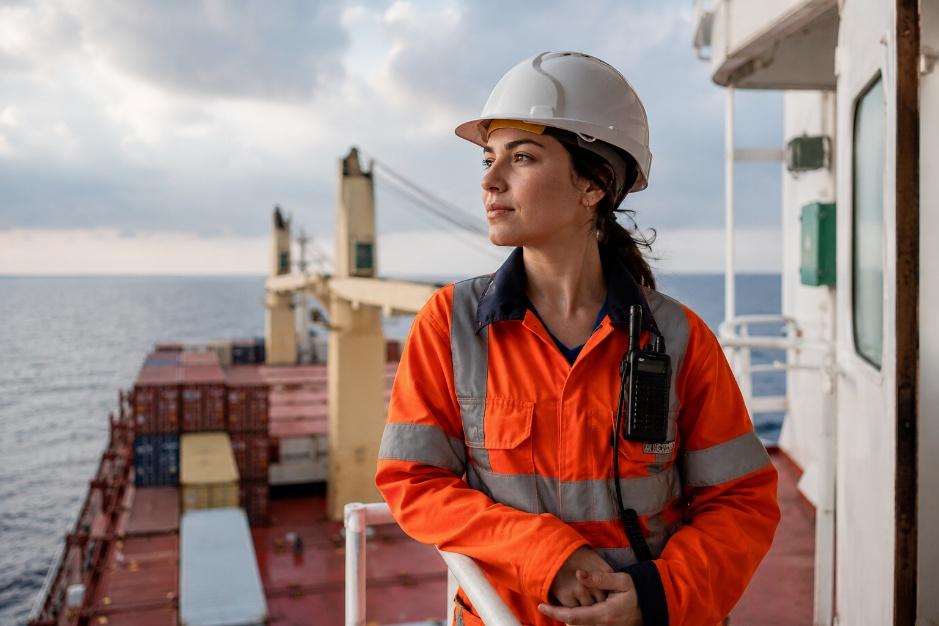
- Properly fitting personal protective equipment (PPE) — already mandatory. The 2022 MLC amendments, already in force, required properly fitting PPE for all seafarers, including clothing and footwear designed specifically for women. I still encounter operators who treat this as an HR footnote. It is not. Ill-fitting gear is a safety deficiency under port state control and a premises-liability exposure. If a female seafarer is injured because her equipment didn’t fit, the gear manufacturer cannot solve that problem for you.
Retention Is the Business Case
The updated guidelines also address the longer term: flexible return-to-sea after maternity leave, inclusive recruitment practices under the Diversity and Inclusion Toolkit for Shipping, and improved digital connectivity to reduce isolation (this often drives retention failures across all seafarers, but most heavily affects those with family responsibilities ashore). Some operators have already introduced phased return programs, but most have not.
The economics are not complicated: amid an officer shortage, retaining a female officer who already knows the vessel, the systems, and the procedures is worth far more than a new replacement. A diverse crew also draws from a larger talent pool, and the study’s evidence supports this produces better overall decision-making aboard.
What to Do Now
1. Audit your PPE inventory. Properly fitting gear for female crew is already a mandatory MLC requirement. Address it before your next port state control inspection.
2. Review and update your anti-harassment policy. It should be current, distributed to all crew, and include a victim safeguarding procedure.
3. Provision your ship’s stores and shared bathrooms.
4. Build the retention infrastructure. Maternity leave policies and phased return-to-sea programs should be part of compliance posture, not separate from it.
We at the Herd Law Firm are proud to fight for seamen, maritime workers, and passengers in all types of personal injury and death claims. As maritime personal injury attorneys — and sailors ourselves — located in northwest Houston, we never waver in our commitment to help maritime workers, passengers, and their families when they are injured or mistreated.
Sources
• International Chamber of Shipping, Guidelines on the Application of the ILO Maritime Labour Convention, Fifth Edition (2026), ics-shipping.org
• BIMCO/ICS, Seafarer Workforce Report (2021), bimco.org / ics-shipping.org
• IMO–WISTA, Women in Maritime Survey (2024), imo.org
• Maritime Labour Convention, 2006 (as amended), ilo.org
• ICS/ITF, Guidance on Eliminating Shipboard Harassment and Bullying, ics-shipping.org
• Maritime Executive, “Updates to Guidelines on the Application of ILO Maritime Labour Convention” (March 24, 2026), maritime-executive.com