
After the Francis Scott Key Bridge fell, the Coast Guard turned the investigation around and asked a harder question — not only what went wrong in Baltimore, but where else it could happen. Its answer names eleven ports, Houston and Galveston among them, and warns that the nation’s bridges and channels were built for a fleet that no longer exists.
On the morning of March 26, 2024, the containership motor vessel (M/V) Dali — nearly 1,000 feet of steel and stacked boxes — lost power outbound from Baltimore and allided with Pier 17 of the Francis Scott Key Bridge.
In admiralty law’s precise vocabulary, a moving vessel that strikes something fixed actually does not collide with it; instead, it allides — a distinction that usually points to where fault begins, since a bridge cannot “steer” into anything. Six people died, the span came down, and the Port of Baltimore closed for months.
Most of what followed investigated what went wrong aboard that one ship. We covered that story as it unfolded — the circumstances, the settlement, and the filing deadlines in the M/V Dali case, and the shipowner’s early move to cap its own liability under a statute written in 1851. The United States Coast Guard (USCG) has now asked something more unsettling — not what happened, but where it could happen next.
The Coast Guard Turns the Lens Around
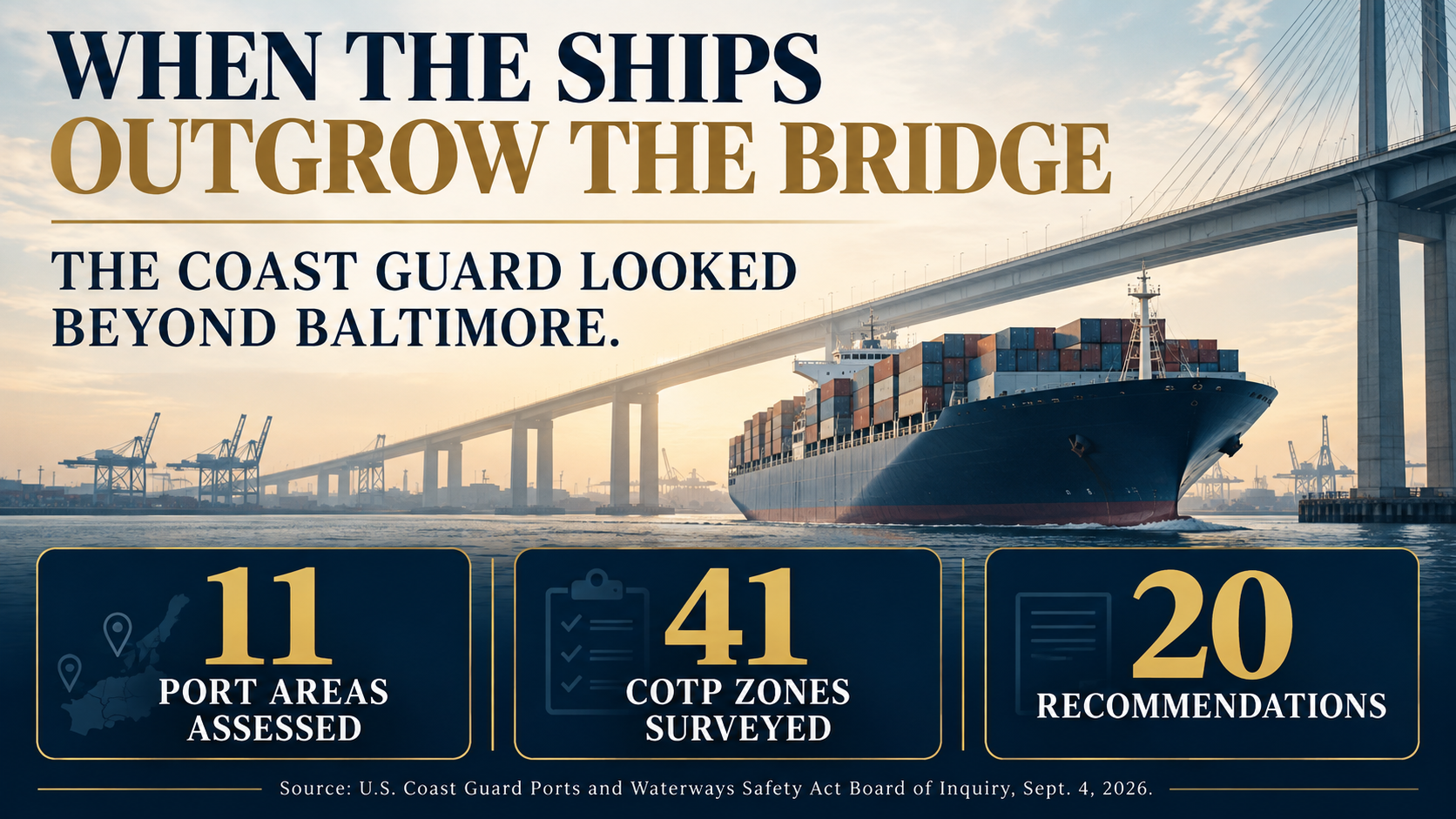
Rather than reinvestigate the casualty itself — the National Transportation Safety Board handled that — the Coast Guard convened a Ports and Waterways Safety Act (PWSA) Board of Inquiry (BOI) to examine what the Key Bridge disaster meant for every other American harbor. Its report, released in early this September 2026, reads less like a post-mortem and more like a warning shot. The Board studied eleven major U.S. port areas, including:
- Cleveland, Ohio
- Corpus Christi, Texas
- Honolulu, Hawaii
- Houston/Galveston, Texas
- Los Angeles/Long Beach, California
- Miami, Florida
- New Orleans, Louisiana
- Port of New York/New Jersey
- Port of Virginia, Virginia
- Providence, Rhode Island/New Bedford, Massachusetts
- Puget Sound, Washington
The report has now reached an important conclusion: the problem was never only Baltimore.
Modern Ships, Older Bridges
The heart of the finding is a fundamental infrastructural mismatch: the size, tonnage, and raw power of today’s containerships can far exceed anything the engineers who designed many American bridges ever considered. The M/V Dali’s pier had a protection system built in; it simply was never meant to absorb a blow like that. Ports across the country told the Board the same story — they are handling larger commercial vessels than they did a decade ago, alongside heavier commercial traffic and a rising tide of recreational boaters sharing the same water.
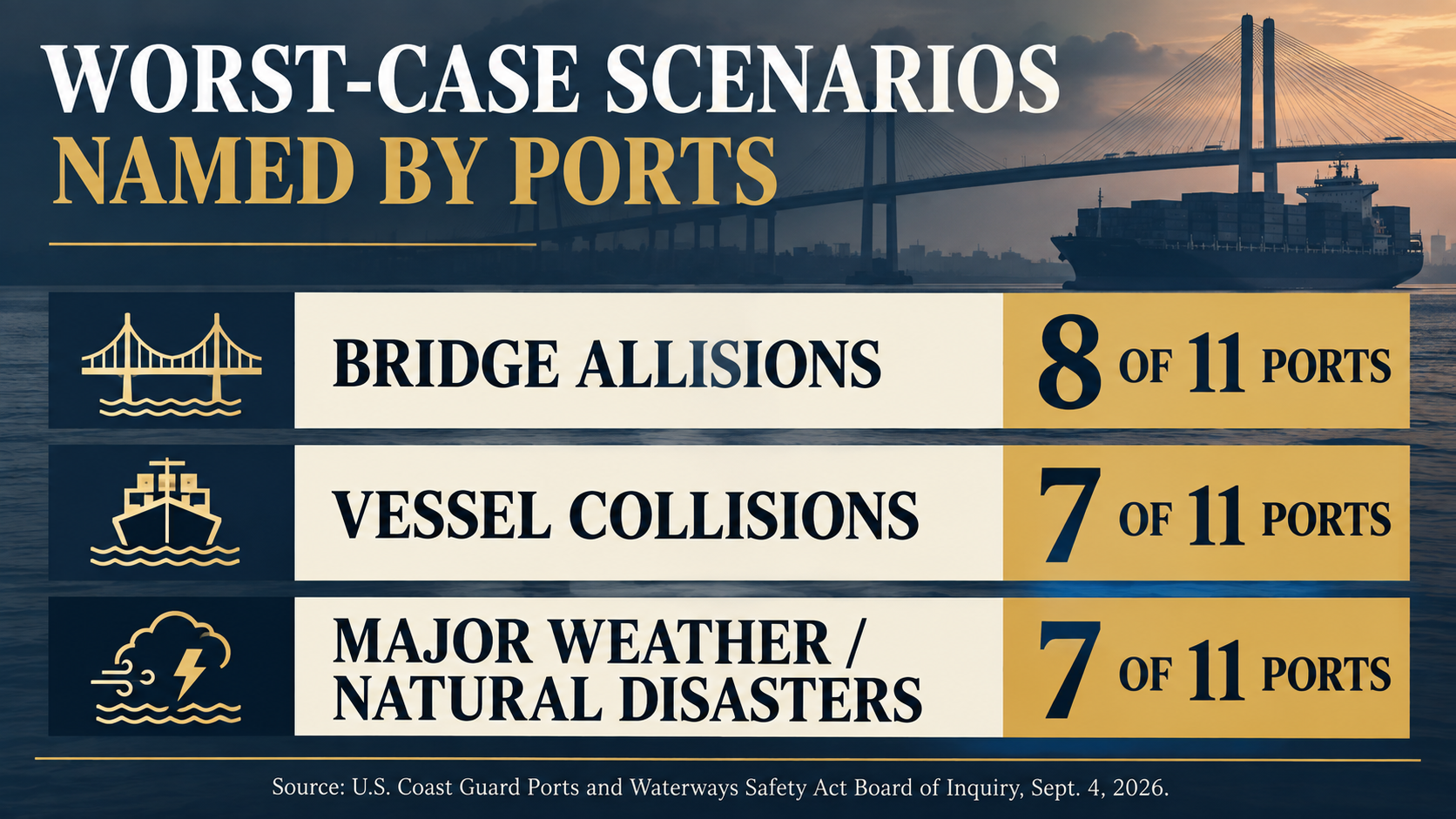
Asked to name their worst-case scenario, the ports answered with striking consistency:
- Bridge allisions — the Dali scenario — were the single most-cited catastrophe, named at eight of the ports studied.
- Vessel collisions and major weather or natural disasters followed close behind, each flagged at seven ports.
- Deepwater channels and bridges ranked as the most critical infrastructure of all.
The Audit Beneath the Audit
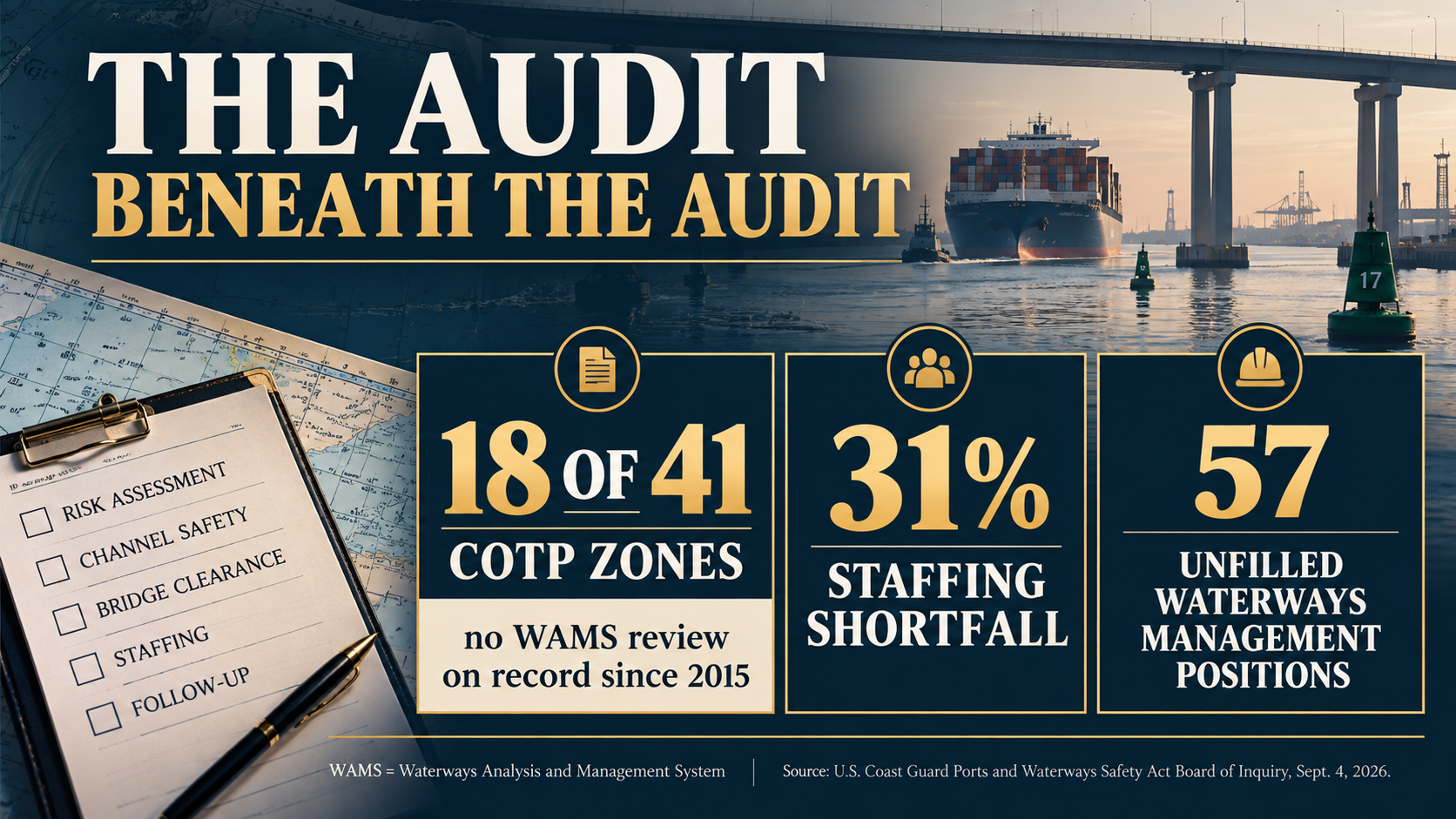
The Board also turned a critical eye on the Coast Guard itself, and here the findings sting. The service’s Waterways Analysis and Management System (WAMS) requires a review of each critical waterway at least once every five years. Yet eighteen of the forty-one Captain of the Port (COTP) zones surveyed had no record of completing one since 2015. The Waterways Management program, the Board reported, is running with an estimated 31 percent staffing shortfall — some fifty-seven unfilled positions — which makes those overdue assessments only harder to catch up on. The risk tools exist, in other words; they are simply going unused.
Any Fixes on the Table?
The Board issued twenty recommendations in all, ranging from building a broader risk-management framework, to creating a central repository for completed assessments, to making the WAMS review process itself more risk-based, so that scarce attention flows first to the most complex and consequential waterways. Port stakeholders added a practical wish list that any Gulf Coast mariner will recognize: more dredging, greater salvage and oil-spill response capacity, additional tug capacity and escort requirements, stronger bridge protection and fendering, and real-time sensors for current, tide, weather, and bridge clearance.
“The tragic Key Bridge incident underscores the urgent need to strengthen our approach to port safety and risk management,” said Rear Admiral Wayne Arguin, who chaired the Board. The Coast Guard is taking public comment through February 28, 2027, and the Commandant’s Final Action Memorandum (FAM) — the document that decides which recommendations become policy — is expected in August 2027.
Why This Reaches the Gulf Coast
Houston and Galveston did not both land on that list of eleven by accident. The Houston Ship Channel is among the busiest and most valuable waterways in the country, connected by bridges and crowded with exactly the kind of ever-larger vessels the Board worries about. Everything the report describes — an aging span, a moment’s lost power, a pilot with seconds to react — could as easily be written about our own water as about Baltimore’s Patapsco.
And when it is, the law is what sorts out the wreckage. A bridge allision is rarely an isolated event; it represents a cascade of issues with the vessel’s condition, her crew, her maintenance, and the choices made by the people who profit from sending her to sea. For the mariners, bridge workers, and waterfront families who can be hurt when steel meets steel, the doctrines that matter most — negligence, unseaworthiness, and a vessel owner’s duty to keep a safe ship — do not change with the locale of the bridge.
The Coast Guard has, in effect, handed the country a map of where the next Key Bridge could potentially happen. The honest response is not to look away from it.
Maritime Trivia Question!
Q: The Board urged better bridge “fendering” — the protective cushioning built around a pier. The word fender turns up everywhere on the water. Where does it come from?
A: It is a worn-down form of defender, from the Old French defendre, “to ward off.” A ship’s fenders — once coils of old rope, now rubber or foam — are simply the structures that “fend off” or protect against a hard impact between hull and dock. A bridge’s fendering system does the same at greater scale, serving as a protective cushion between the pier and a alliding object.
We at the Herd Law Firm are proud to fight for seamen, maritime workers, and passengers in all types of personal injury and death claims. As maritime attorneys (and sailors ourselves!) located in northwest Houston, we never waver in our commitment to help maritime workers, passengers, and their families when they are injured or mistreated.
The information in this post is for general informational purposes only and does not constitute legal advice. For questions specific to your maritime law issue, please contact us at 713-955-3699 or at Charles.Herd@HerdLawFirm.com.
Sources
- Schuler, Mike. “Coast Guard Key Bridge Inquiry Finds U.S. Ports Facing Growing Risks from Larger Ships.” gCaptain, September 4, 2026. gcaptain.com
- “U.S. Coast Guard Inquiry Finds Port Safety & Infrastructure Gaps After Baltimore Key Bridge Disaster Involving M/V Dali.” Marine Insight, September 2026. marineinsight.com
- U.S. Coast Guard. “Ports and Waterways Safety Board of Inquiry” (final redacted report and convening memo). news.uscg.mil
- Herd, Charles F. “The M/V DALI Key Bridge Collapse: Circumstances, Settlement, and the Statute of Limitations.” Herd Law Firm. herdlawfirm.com
- Herd, Charles F. “The Baltimore Bridge Collapse, Part II: Today’s Legal Battle Over Baltimore’s Bridge Disaster.” Herd Law Firm. herdlawfirm.com

Leave A Comment
You must be logged in to post a comment.