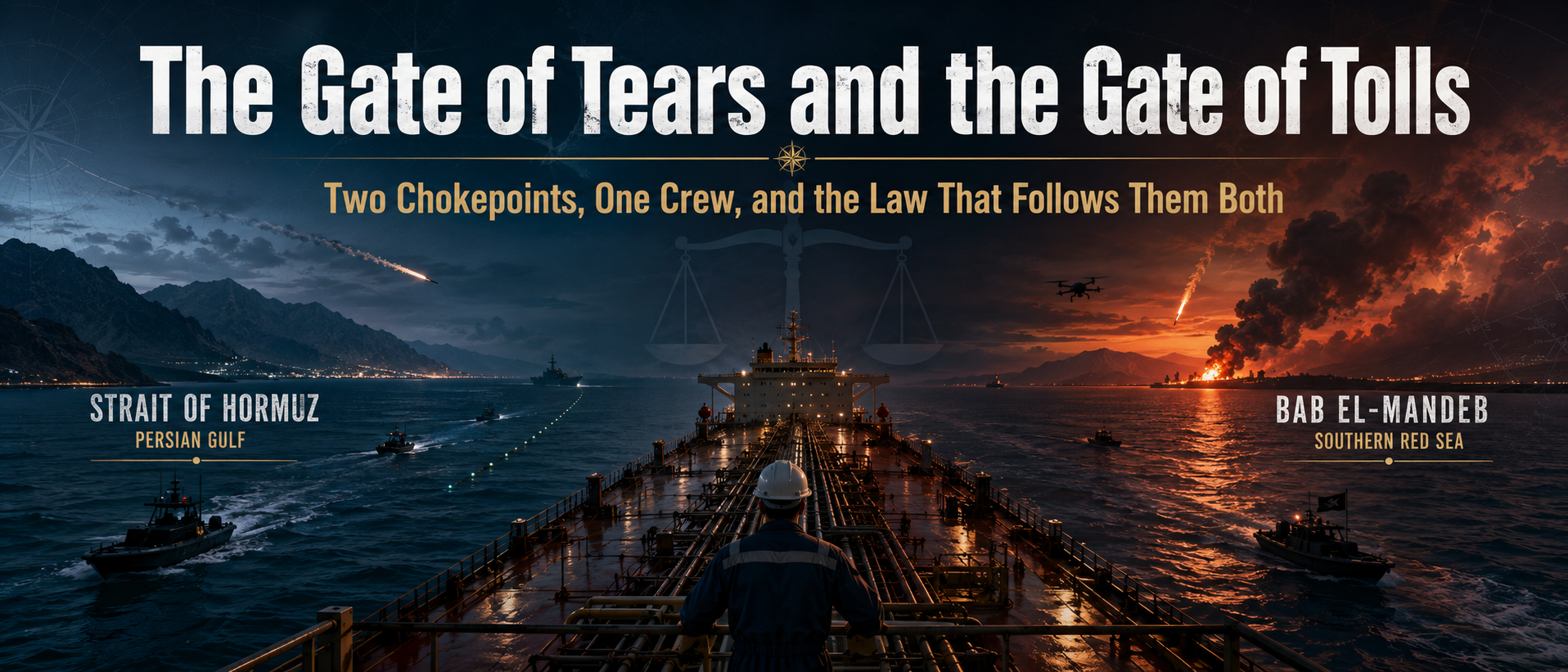
Two Chokepoints, One Crew, and the Law That Follows Them Both
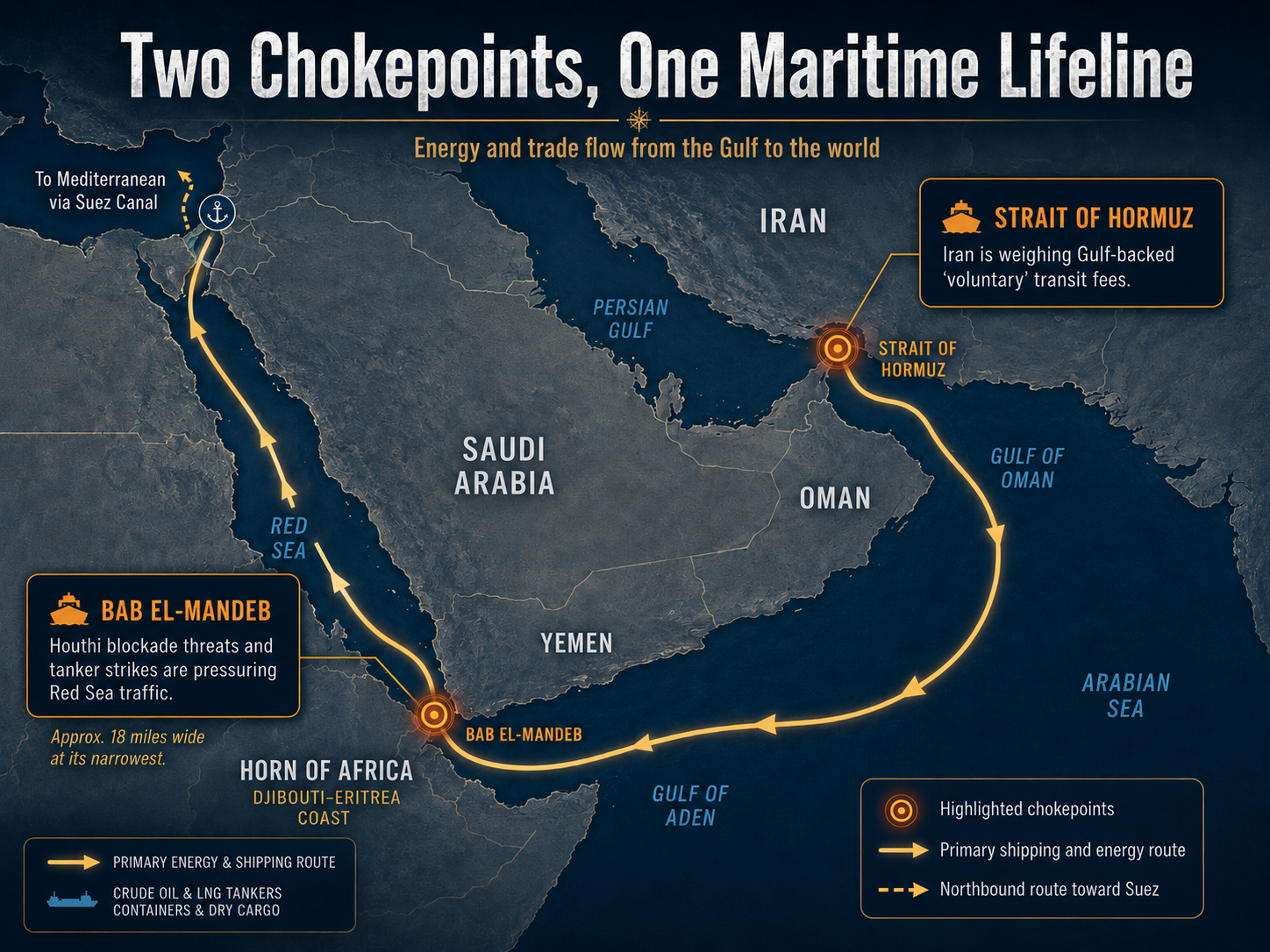
Iran is weighing a Gulf-backed plan to charge “voluntary” tolls in the Strait of Hormuz just as Yemen’s Houthis try to copy that playbook in the Red Sea — a fourth Saudi-linked tanker was struck this week. For the mariners caught between the two gates, U.S. maritime law does not stop at the water’s edge, and it does not stop at the U.S. Gulf coast either.
There is an old habit among sailors of naming the dangerous places plainly. The southern mouth of the Red Sea has been called the Bab el-Mandeb — the “Gate of Tears” — for centuries, long before any missile was fired across it. This week the world has two such gates to watch. At one end of the Arabian Peninsula, the Strait of Hormuz is inching from open war toward an argument about money. At the other, the Gate of Tears is filling again with the smoke of struck tankers. Between them sit the crews who keep the fuel moving, and behind them stands a body of American law built for exactly this moment.
A WAR THAT PAUSED, BUT DID NOT END
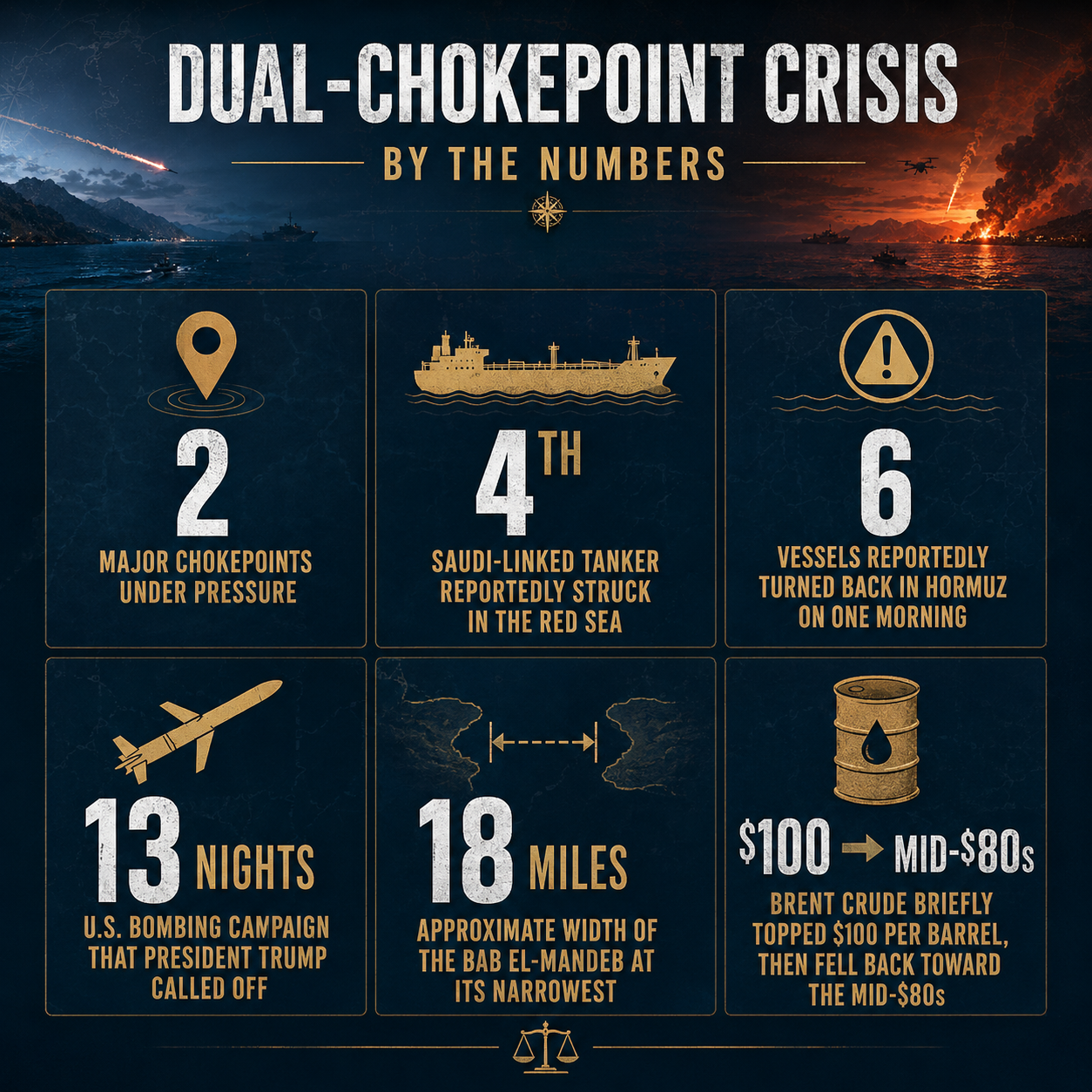
The most immediate news out of Hormuz is a quiet one: the guns have gone still, for now. Over the weekend, President Trump called off a renewed thirteen-night U.S. bombing campaign against Iran after military commanders advised that the effort — aimed at breaking Tehran’s grip on the strait — had reached the limit of what it could accomplish. Iran, for its part, said it would hold its fire only so long as Washington held its own.
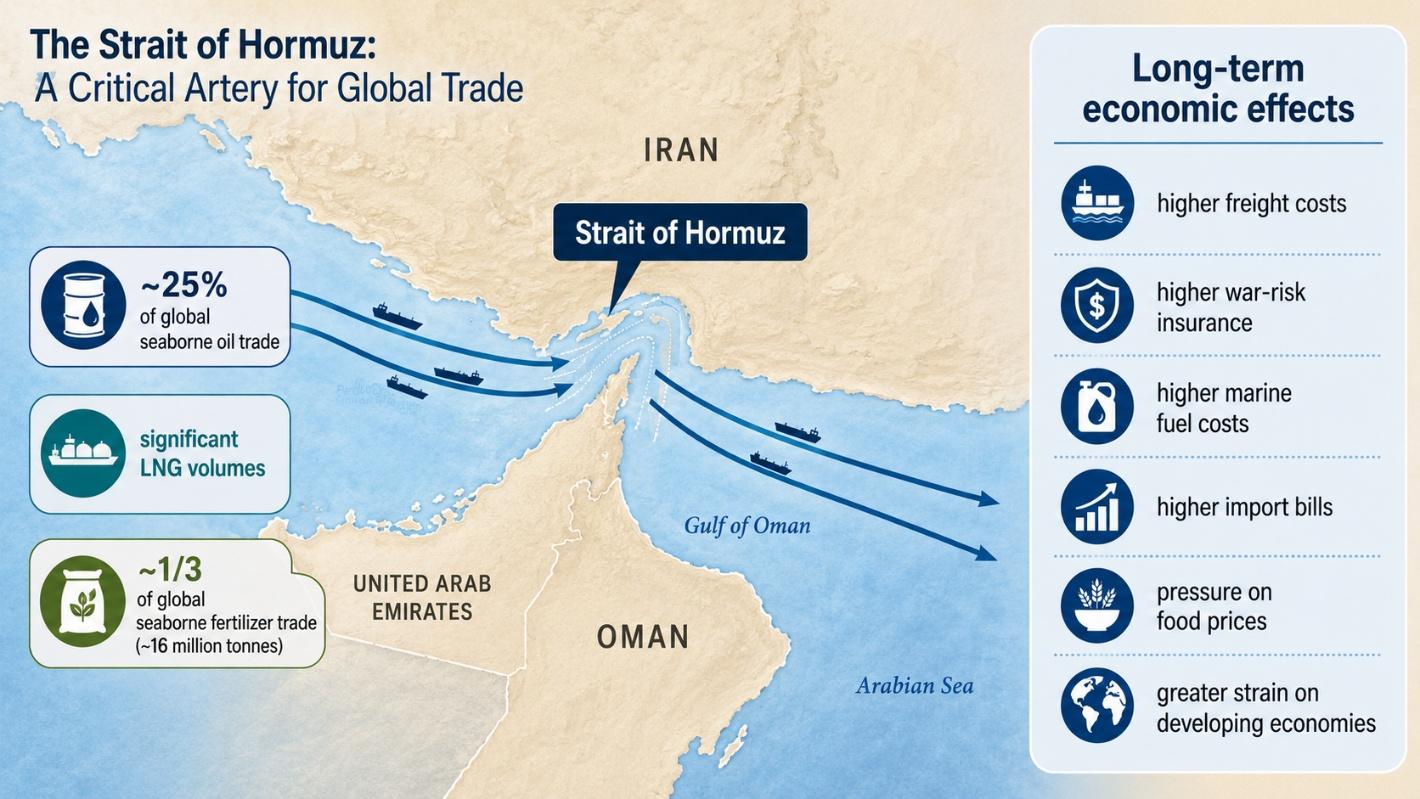
A pause is not a peace. Iran promptly announced that it remained in control of the world’s most important energy waterway, with state media reporting that six “offending” vessels were turned back on a single morning for attempting to cross without permission — one of them, the report said obliquely, having suffered “an accident.” The underlying dispute is unchanged: the United States insists the June framework requires Iran to allow free passage, while Iran reads the same memorandum as granting it the authority to supervise transit. Oil markets exhaled at the ceasefire — Brent crude, which briefly topped $100 a barrel last week, fell back toward the mid-$80s — but the ships are still threading a needle.
FROM A TOLL BOOTH TO A TIP JAR: OMAN’S REJECTED VOLUNTARY-FEE PLAN
Into that uneasy quiet, the Sultanate of Oman floated a compromise. Oman had proposed a Gulf-backed arrangement under which Iran and Oman would jointly manage the Strait of Hormuz, with ships invited to make voluntary contributions toward navigation, environmental protection, and search-and-rescue services. Iran would no longer exercise sole control, and the arrangement would resemble the voluntary contribution system used by Indonesia, Malaysia, and Singapore in the Strait of Malacca.
On Wednesday, however, a senior Iranian official told Reuters that the proposal had “no chance of success.” Tehran insisted that the entire inbound route through the strait, together with part of the outbound route, must remain under Iranian control. A proposed 50-50 management arrangement with Oman would not serve Iran’s interests, the official said, while accusing the United States and Saudi Arabia of pressuring Oman to advance what Iran described as “unrealistic plans.”
Iran’s Islamic Revolutionary Guard Corps (IRGC) also announced the same day that its naval forces had struck three oil tankers in the strait and forced them to stop after they allegedly ignored warnings and followed an “unsafe and illegal route.” The IRGC declared that it continued to maintain full control over the waterway and warned that U.S. military interference or instructions to commercial vessels would not go unanswered.
The proposed “tip jar,” in other words, never had the opportunity to replace the “toll booth”. Iran continues to treat control of the strait as a matter of sovereignty and strategic leverage, not a shared logistical management.
With renewed attacks ending the brief pause in fighting and oil prices rising by more than $3 per barrel on Wednesday, the question facing shipowners and crews is no longer whether a voluntary contribution might become coercive, but whether any transit arrangement can survive while the parties disagree over who controls the channel — and while tankers attempting to pass remain exposed to warnings, interception, and attack.
THE SECOND GATE: THE HOUTHIS COPY THE PLAYBOOK
If Hormuz is learning to charge for passage, the Red Sea is relearning how to deny it. Yemen’s Iran-aligned Houthi movement declared a naval blockade on Saudi shipping in mid-July and has been making good on the threat in the Bab el-Mandeb, the eighteen-mile-wide strait between Yemen and the Horn of Africa that guards the southern approach to the Suez Canal.
The intent is now stated openly. Yemen’s foreign minister-designate, Afrah Al-Zouba, told reporters in Riyadh that the Houthis “want to copy the Iranian model,” a strategy she warned could “shut down two main straits, the gateways into the Gulf and Red Sea.” The attacks have followed in short order:
- This week the Houthis claimed a fourth strike on a Saudi-linked tanker since announcing the blockade, saying they hit the Saudi-flagged chemical and products carrier M/T NCC Ghazal with ballistic missiles in the southern Red Sea near Jizan and forced her to turn back.
- The UK Maritime Trade Operations (UKMTO) center — a Royal Navy-run body that advises merchant ships — reported that a tanker’s master heard an explosion while transiting the same waters, adding that the crew and vessel were safe and that no pollution had been reported.
- The Houthis also said they targeted crude-oil supply and transport sites linking eastern Saudi Arabia to its Red Sea export hub at Yanbu — the very route Riyadh had been using to bypass the trouble in Hormuz. Ship-tracking firms recorded a sharp drop in Bab el-Mandeb traffic as tankers with Saudi cargo turned around rather than run the gauntlet.
Saudi Arabia has answered with airstrikes on what it calls Houthi military facilities and has vowed to protect commercial shipping. Diplomats and Yemeni officials now describe a return to full-scale war in Yemen as more likely than at any point since the 2022 truce. The upshot for the maritime world is the scenario long dreaded in insurance and shipping circles: a dual-chokepoint crisis, with the two great gates of Middle East energy under pressure at the same time, and diversion capacity already stretched thin.
WHY TWO DISTANT STRAITS REACH THE HOUSTON SHIP CHANNEL
It is fair to ask what a toll dispute off Bandar Abbas or a missile off Jizan has to do with a deckhand on the Texas Gulf Coast. The answer is that the American crews who work the Gulf Coast are part of the same global rotation, on the same hulls and under the same flags, that move oil and liquefied natural gas (LNG) through these waters. When owners weigh whether to send a ship — and a crew — into a place where navies have already opened fire, they are making a decision that U.S. maritime law examines closely. And the mariner’s core protections do not evaporate at the edge of a war-risk zone. They travel with the seaman, whether the hazard is a hurricane in the Gulf or a drone over the Red Sea.
WHAT U.S. MARITIME LAW SAYS WHEN THE EMPLOYER CONTROLS THE RISK
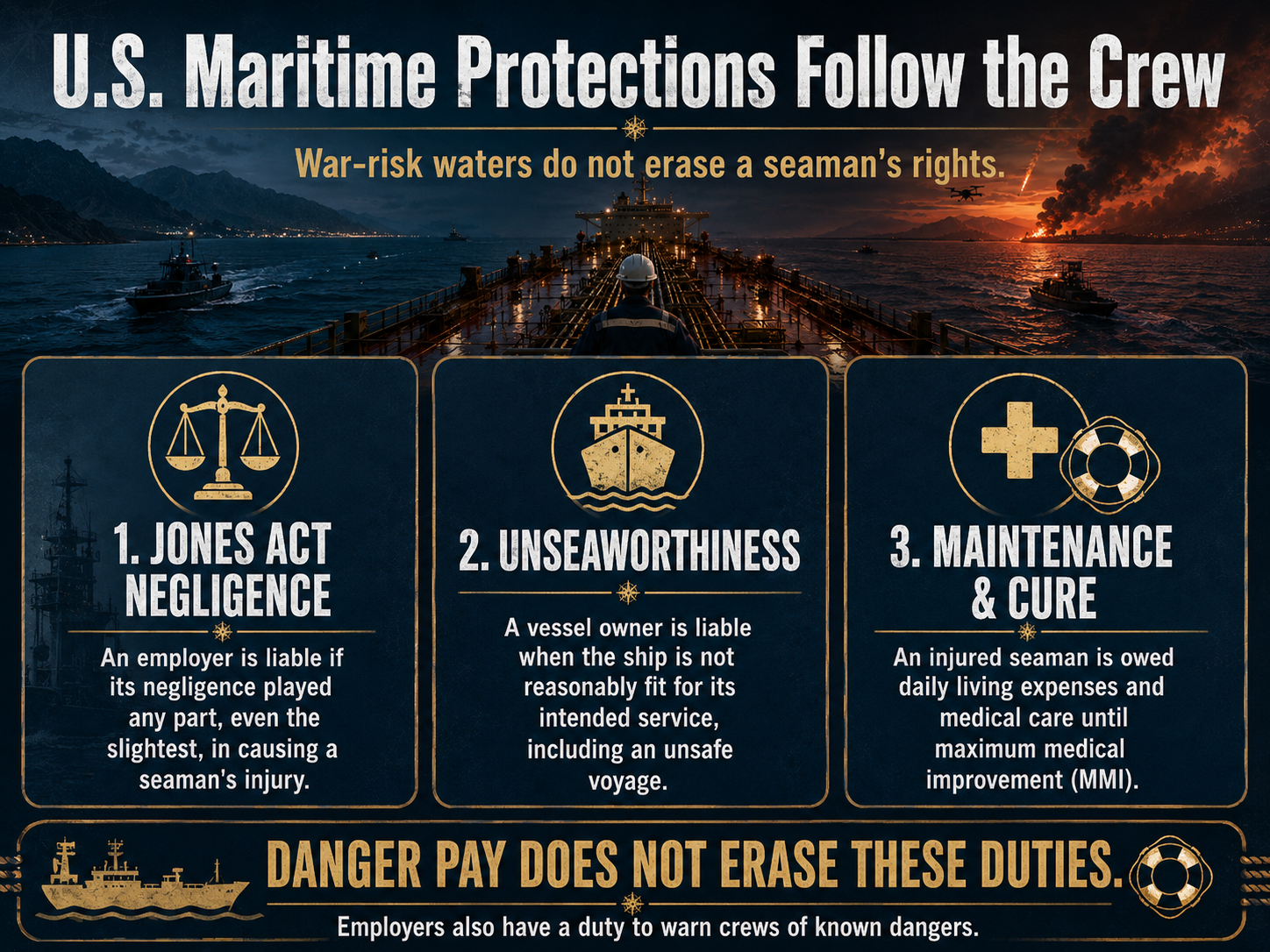
The U.S. Jones Act and the U.S. General Maritime Law were built around a plain fact of the trade: a sailor often cannot simply walk off the job when conditions turn dangerous, because the ship is both the workplace and the only way home. When the employer controls whether a crew sails into harm’s way, the law places heavy obligations on that employer. Three of them bear directly on a dual-chokepoint voyage:
- Jones Act negligence. Under the Jones Act (46 U.S.C. § 30104), an employer is liable if its negligence played “any part, even the slightest” in causing a seaman’s injury. That famously low bar reflects a deliberate congressional judgment: those who profit from sending sailors to sea must answer when those sailors are harmed. Ordering a vessel into a strait where forces have already fired on merchant ships — after regulators have warned against it and insurers have priced the danger — is exactly the sort of decision that invites the inquiry.
- Unseaworthiness. The General Maritime Law holds a vessel owner strictly liable — that is, liable without any showing of fault — when the ship is not “reasonably fit” for its intended service, whether the defect lies in equipment, crew, or the voyage ordered. A run into an active combat corridor — without adequate protection — communications, or a lawful way to comply with blockade instructions could well fall short of that standard.
- Maintenance and cure. This ancient duty requires an owner to cover an injured seaman’s daily living expenses (“maintenance”) and medical costs (“cure”), regardless of fault, until the seaman reaches maximum medical improvement (MMI) — the point at which further treatment will not improve the condition. The U.S. Supreme Court in Vaughan v. Atkinson, 369 U.S. 527 (1962), made clear that courts read these obligations broadly and resolve doubts in the seaman’s favor.
Layered on top is an affirmative duty to warn the crew of known dangers, and, in the contracts and collective bargaining agreements that govern conflict-zone work, a set of war-risk provisions — hazard bonuses, enhanced insurance, and often a protected right to refuse an unsafe voyage. We examined how those pieces fit together in Six Months’ Pay to Cross a Minefield? What the Law Says About Buying a Crew’s Consent, and at the quieter, transponders-off tactics owners have used to slip vessels through in Running Dark Through Hormuz: The Quiet Campaign to Keep Shipping Moving. The common thread: money offered for danger does not, by itself, buy away the employer’s duties or the seaman’s rights.
These questions are not confined to foreign flags. The same conflict has already reshaped the domestic fleet through repeated waivers of the Jones Act’s coastwise trade rules — a development we tracked in The Waiver That Will Not Weigh Anchor: The White House Weighs a Third U.S. Jones Act Extension. A waiver may change which ships carry the cargo; it does not change the duty owed to the men and women aboard them.
THE WATCH DOES NOT END WHEN THE HEADLINES DO
A voluntary fee at one gate and a blockade at the other are, for the crews involved, two versions of the same problem: someone ashore is deciding how much danger a working sailor must absorb, and how much they will be paid — or fired upon — for absorbing it. The law’s answer is not that danger is forbidden. Sailors have always gone where the sea is worst. Its answer is that the party who profits from the voyage cannot send the crew blind, cannot send them unprotected, and cannot buy its way out of caring for them when the worst arrives.
That principle guards a tankerman off Yemen and a barge hand on the Intracoastal Waterway with equal force. A seaman does not surrender the Jones Act, maintenance and cure benefits, or the right to a seaworthy vessel simply by working somewhere dangerous. Those are precisely the waters where the rights matter most — and someone still has to keep standing at the rail through the quiet, uncertain hours after the shooting starts.
Maritime Trivia Question!
Q: The Bab el-Mandeb is often translated as the “Gate of Tears.” Sailors’ lore ties the name to shipwreck and grief — but where does it most likely come from?
A: From the Arabic bāb (“gate”) and al-mandab (“of lament” or “of mourning”). Popular legend attributes the name to the many mariners lost in its narrow, reef-strewn, wind-whipped waters — and honesty compels a footnote here, because that romantic explanation is exactly the kind folk etymology loves and historians distrust. A competing account traces the name to an old myth in which an earthquake tore Arabia from Africa, drowning countless souls in the new-made channel. Either way, the ancients who named it were marking the same truth modern charts still respect: this is a hard, narrow gate, and it has always asked a toll in caution.
We at the Herd Law Firm are proud to fight for seamen, maritime workers, and passengers in all types of personal injury and death claims. As maritime personal injury attorneys (and sailors ourselves!) located in northwest Houston, we never waver in our commitment to help these maritime workers, passengers, and their families when they are injured or mistreated.
The information in this post is for general informational purposes only and does not constitute legal advice. For questions specific to your maritime law issue, please contact us at 713-955-3699 or at Charles.Herd@HerdLawFirm.com.
Sources
- Azhari, Timour, and Parisa Hafezi. “Oman Floats Gulf-Backed Plan to Manage Strait of Hormuz With Voluntary Transit Fees.” Reuters / gCaptain, July 28, 2026. https://gcaptain.com/gulf-states-back-plan-to-let-iran-collect-voluntary-fees-to-use-hormuz/
- Abdallah, Nayera, and Elwely Elwelly. “Iran Says It Still Controls Strait, Not Seeking Talks, After Trump Halts Bombing.” Reuters, July 27, 2026.
- Schuler, Mike. “Houthis Claim Fourth Attack on Saudi Tanker as Red Sea Blockade Intensifies.” gCaptain, July 28, 2026. https://gcaptain.com/houthis-claim-fourth-attack-on-saudi-tanker-as-red-sea-blockade-intensifies/
- “Yemen’s Houthis Claim Missile Attack on Saudi Arabia Oil Tanker.” Al Jazeera, July 28, 2026. https://www.aljazeera.com/news/2026/7/28/yemens-houthis-claim-missile-attack-on-saudi-arabia-oil-tanker
- “Houthis to Model Iran’s Hormuz Control in Red Sea.” Reuters / gCaptain, July 27, 2026.
- “Houthis Deploy Missiles and Drones to Attack Ships in Southern Red Sea, Naval Group Says.” CNBC, July 22, 2026. https://www.cnbc.com/2026/07/22/houthis-red-sea-bab-el-mandeb-saudi-oil-iran.html
- “The Strait of Hormuz Isn’t the Only Vital Chokepoint Under Threat.” The National Interest, July 23, 2026. https://nationalinterest.org/blog/buzz/strait-of-hormuz-isnt-only-vital-chokepoint-under-threat-ps-072326
- Legal Information Institute, Cornell Law School. “46 U.S. Code § 30104 — Personal injury to or death of seamen” (the Jones Act). https://www.law.cornell.edu/uscode/text/46/30104
- Vaughan v. Atkinson, 369 U.S. 527 (1962).