Champagne on a bow is one of the few workplace rituals that still draws an exciting crowd. The one broken in Philadelphia last week ended a twenty-one-year wait for the Texas A&M Maritime Academy — and put a 524-foot federal asset on course for Galveston.
On July 17, 2026, at the Hanwha Philly Shipyard, Rachel Campos-Duffy — wife of U.S. Transportation Secretary Sean P. Duffy — swung a bottle across the bow of the TS LONE STAR STATE, the fourth of five National Security Multi-Mission Vessels (NSMVs) being built for America’s state maritime academies under the U.S. Maritime Administration (MARAD). She will be delivered to the Academy’s Galveston campus later this year.
Texas A&M Maritime Academy has gone twenty-one years without a large training ship to call its own, since its last one was recalled. So this is not a logistics update. It is a homecoming — and, for the Sea Aggies who will sail her, the start of a working life afloat.
A Ship to Teach
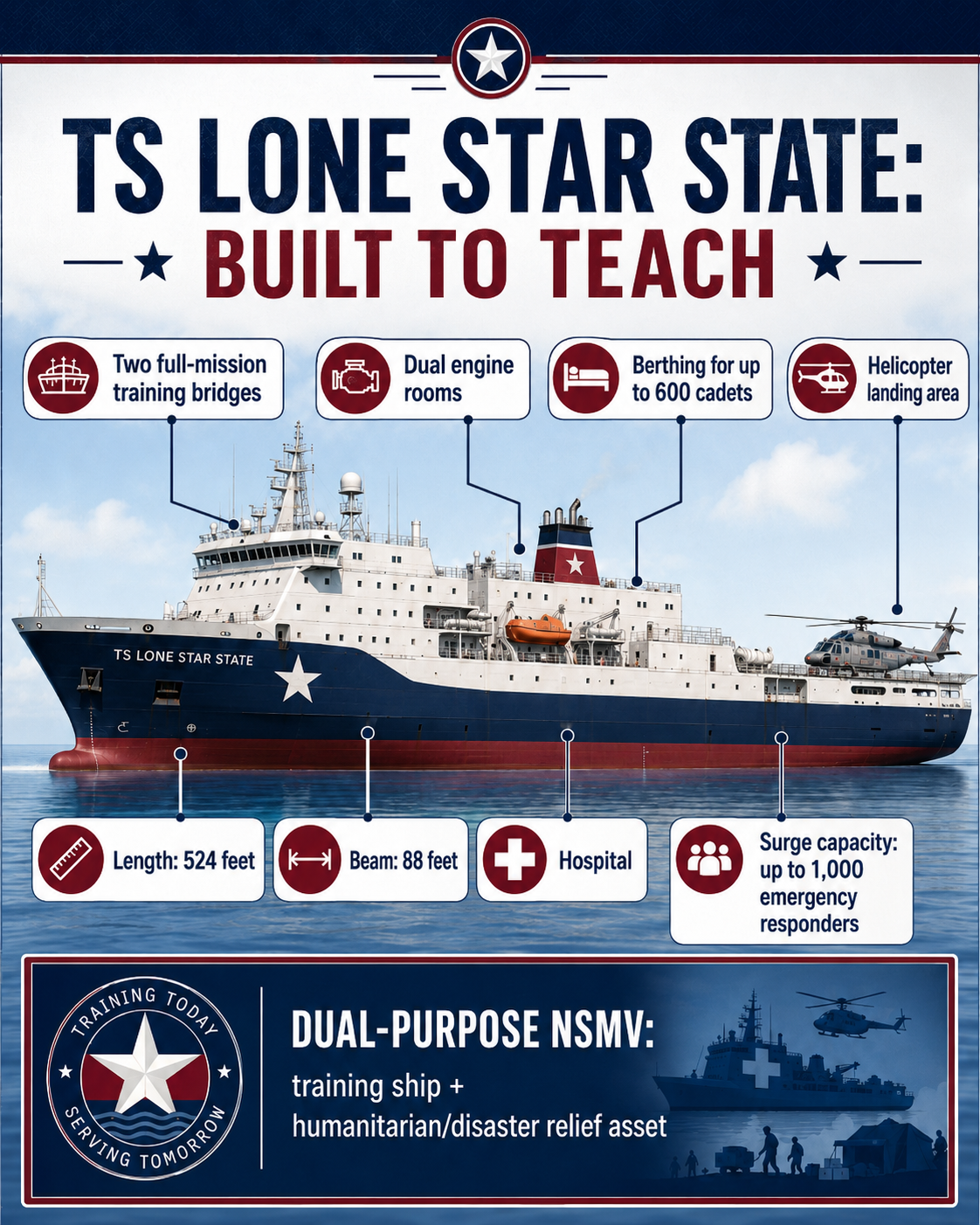
The TS LONE STAR STATE measures 524 feet with an 88-foot beam, and she was drawn from the keel up for instruction rather than adapted into it. Her particulars read like a wish list assembled by the Texas A&M instructors who have spent two decades teaching on borrowed and aging tonnage:
- Two full-mission training bridges, so cadets stand real watches rather than take turns watching;
- Dual engine rooms, doubling hands-on time below;
- Modern instructional spaces built for the curriculum instead of retrofitted around it;
- A hospital and a helicopter landing area;
- Berthing for up to 600 cadets — or as many as 1,000 emergency responders when the ship is called to federal service.
That final figure is the reason the class carries “National Security” in its name. The NSMV is dual-purpose by design: a training platform in ordinary times, and a humanitarian assistance and disaster relief (HA/DR) asset when the U.S. Gulf Coast — or anyone else — needs one. Anyone who lived through Hurricane Harvey understands immediately what a thousand berths and a helicopter deck are worth when the roads are underwater.
Why the Country Is Building Them
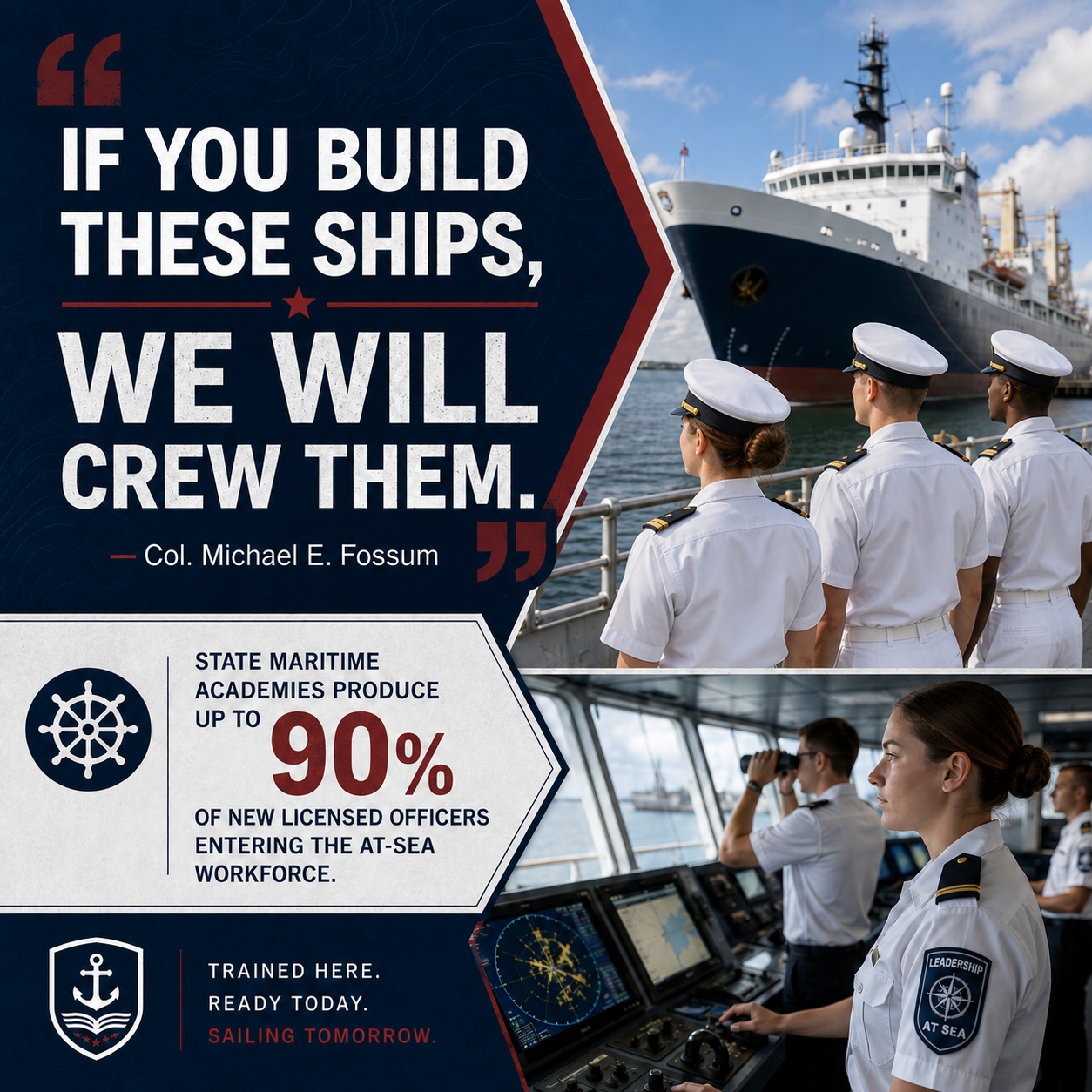
The program exists because of arithmetic: the United States faces a persistent shortage of licensed merchant mariners, and the state maritime academies produce up to 90 percent of the new licensed officers entering the at-sea workforce. Build the ships, and the officers follow. Col. Michael E. Fossum — superintendent of the Texas A&M University Maritime Academy, former NASA astronaut, and Class of ’80 — put it plainly at the ceremony: “If you build these ships, we will crew them.” Texas A&M is already holding up its end: the Academy reports that mere anticipation of the vessel has produced a surge in Galveston enrollment for the fall, with cadets signing on to train aboard a modern platform rather than a hand-me-down.
The five NSMVs are being built by Hanwha Philly Shipyard under a Vessel Construction Manager (VCM) model led by TOTE Services, a commercial-management approach program officials credit with holding cost and schedule. The first three went to SUNY Maritime, Massachusetts Maritime, and Maine Maritime; the fifth and final ship, the TS GOLDEN STATE, is scheduled for delivery to California State University Maritime Academy in 2027. At the same christening, the administration announced a $2 billion investment to build two new Missile Range Instrumentation Vessels (MRIVs) at the same yard for the Missile Defense Agency, under the same construction model.
The Cadets Aboard Her are Texas Working Mariners
A christening is a celebration, but a sea term — the extended training voyage each Texas A&M cadet must complete at sea to sit for a Coast Guard license — is a job. Aboard the TS LONE STAR STATE, Aggie cadets will handle lines, stand bridge and engine room watches, work aloft and over the side, and launch boats: the same tasks, with the same hazards, that put mariners in our office. Four points of law follow them up the gangway:
- Seaman status is functional, not ceremonial. Protection under the Jones Act (46 U.S.C. § 30104) turns on a person’s connection to a vessel in navigation and their contribution to its function — not on the title printed on a uniform.
- Unseaworthiness is a strict standard. Under the General Maritime Law, an owner owes an absolute duty to furnish a reasonably fit vessel, gear, and crew. Newness is no defense: a brand-new ship with a defective piece of equipment or an inadequately trained watch is as unseaworthy as an old one.
- Maintenance and cure attaches regardless of fault. A seaman injured or taken ill in the service of the vessel is owed daily living expenses and medical care until reaching maximum medical improvement (MMI).
- The duty to warn travels with the voyage. Employers must warn crew of known hazards — a duty that matters most aboard a ship whose entire purpose is that the people aboard are still learning.
Sovereign-immunity and public-vessel questions can complicate claims involving federally owned tonnage operated by a state maritime academy, and that analysis is genuinely fact-specific. Which is precisely why an injured cadet should never assume the answer is “nothing.”
A Texas Ship, and a Texas Watch
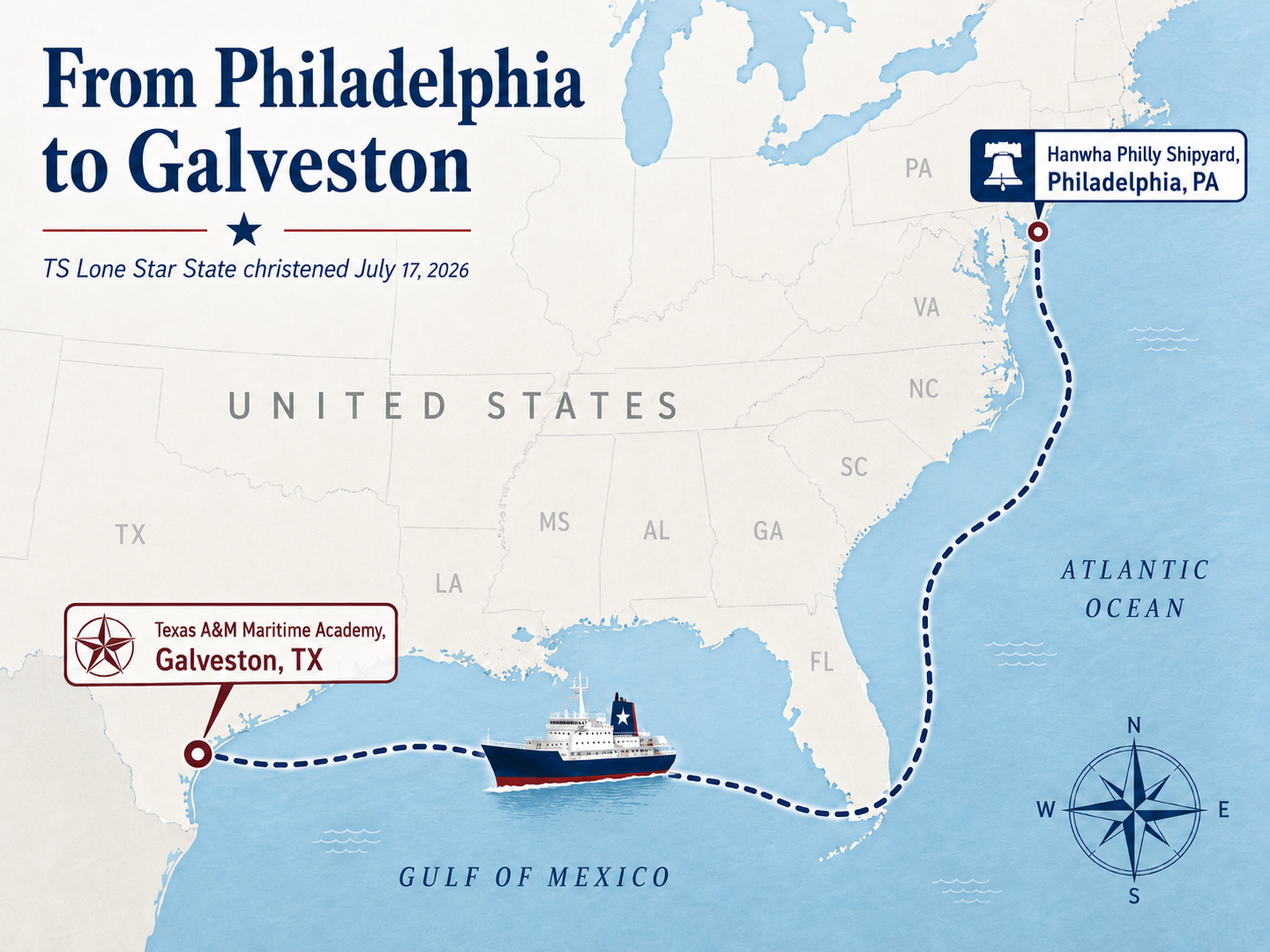
In a few months she will be ours — moored at the Texas A&M Maritime Academy in Galveston, carrying Aggie cadets offshore and returning them to the Houston Ship Channel, the Intracoastal Waterway, the offshore fields, and the blue water beyond. The officers who will run this coast for the next forty years are about to learn their trade aboard her.
A ship is a promise made in steel. The bottle and the bunting are the easy half of it; the rest is kept quietly, over decades, by people standing watches nobody photographs.
Fair winds to her, and to every cadet who will call her home.
Maritime Trivia Question!
Q: We say a new ship is “christened” and that a woman “sponsors” her — but why is a bottle broken across the bow at all, and why champagne?
A: The ceremony is one of the oldest surviving rituals in seafaring, and it began as a libation. Babylonians, Greeks, Romans, and Norsemen all poured wine — or, in some accounts, blood — over a new hull as an offering for the vessel’s safe return. The Royal Navy long used a silver “standing cup” of wine, poured over the deck and then flung into the sea, until the expense of the silverware prompted a switch to simply smashing the bottle against the bow. Champagne became the standard in the nineteenth century as the celebratory wine of the age. Sailors still watch closely: a bottle that fails to break on the first swing is reckoned an ill omen — which is why modern sponsors are often handed a bottle scored to break, and a good backswing.
We at the Herd Law Firm are proud to fight for seamen, maritime workers and passengers in all types of personal injury and death claims. As maritime personal injury attorneys (and sailors ourselves!) located in northwest Houston, we never waver in our commitment to help these maritime workers, passengers, and their families when they are injured or mistreated.
The information in this post is for general informational purposes only and does not constitute legal advice. For questions specific to your maritime law issue, please contact us at 713-955-3699 or at Charles.Herd@HerdLawFirm.com.
Sources
- Schuler, Mike. “Texas A&M’s Lone Star State Christened as Fourth National Security Multi-Mission Vessel.” gCaptain, July 20, 2026. gcaptain.com
- “Fourth NSMV Lone Star State Christened for Texas A&M Maritime Academy.” MarineLink, July 2026. marinelink.com
- “Texas A&M Maritime Academy Celebrates Christening of New Training Ship.” The Maritime Executive, July 20, 2026. maritime-executive.com
- Texas A&M University at Galveston Newsroom. “Texas A&M University Maritime Academy Training Ship LONE STAR STATE Christened in Philadelphia,” July 17, 2026. news.galveston.tamu.edu
- Texas A&M University at Galveston. “TS Lone Star State” (vessel particulars and program details). tamug.edu
- Texas A&M University at Galveston Newsroom. “Texas A&M Maritime Academy NSMV Name Announced,” May 7, 2021. news.galveston.tamu.edu
- Legal Information Institute, Cornell Law School. “46 U.S. Code § 30104 – Personal injury to or death of seamen” (the Jones Act). law.cornell.edu