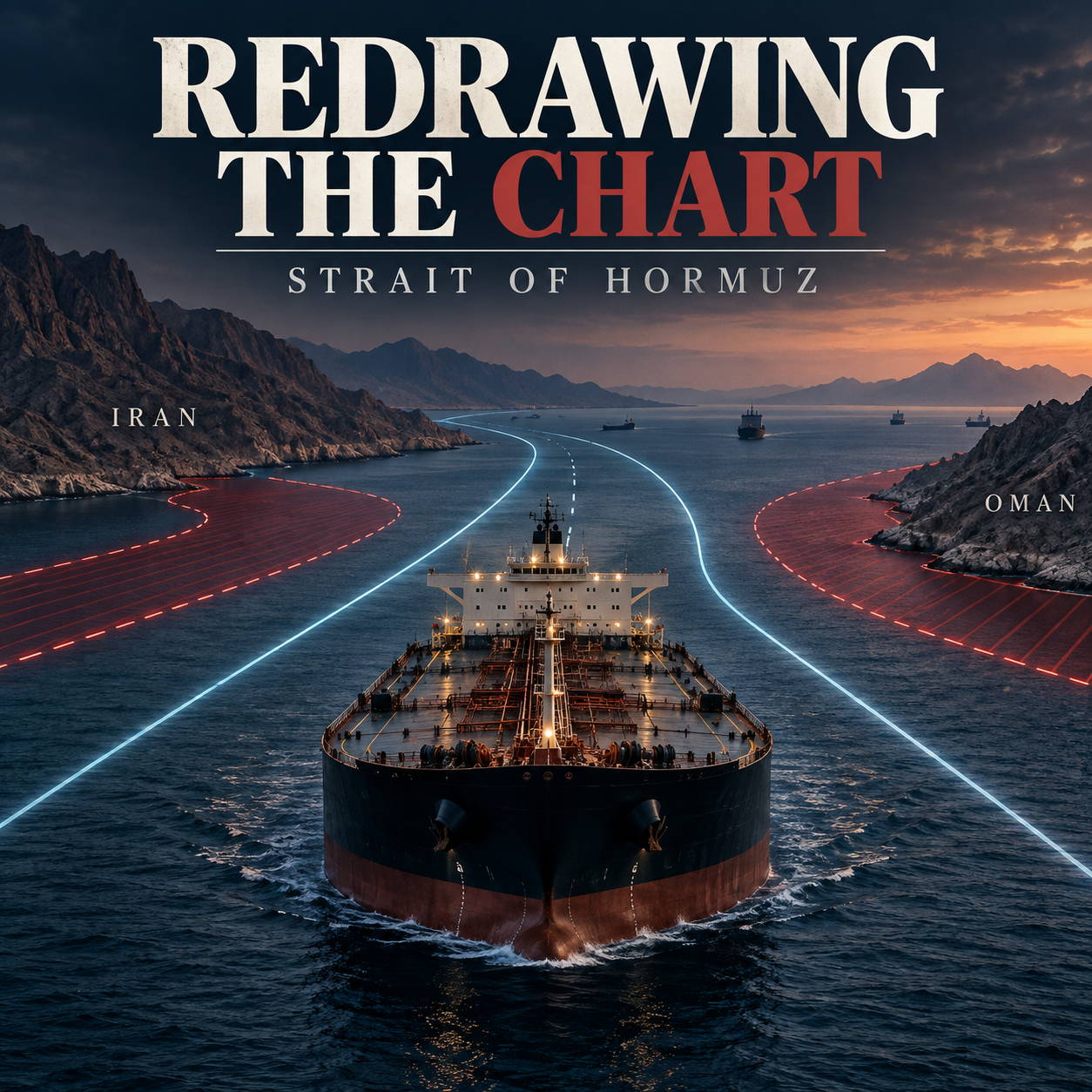
Tehran says it will soon publish maps of a new “international corridor” through the Strait of Hormuz, along with a “restricted zone” in the Gulf and warns that any ship straying outside the approved lane could land on its sanctions list. Days later, the main pipeline built to bypass the Strait was struck and shut down — closing the door and the detour at once. It is the next chapter in a story we have been following all year, and its wake runs straight to the U.S. Gulf Coast.
Upon reaching the edge of the known world, ancient mapmakers used to write hic sunt dracones — “here be dragons.” To sailors, it represented a warning and a confession as to the unknown dangers past such a line. Last weekend, Iran began drawing lines of its own across one of the most consequential stretches of water on earth, and the meaning it communicates is not so different.
Mohsen Rezaei, secretary of Iran’s Supreme National Security Council, told state television that Tehran will announce a new “restricted zone” in the Gulf “in the coming days,” together with maps of a new shipping corridor through the Strait of Hormuz — the narrow chokepoint through which roughly a fifth of the world’s oil moved before the current conflict. “The maps of a new international corridor which lies in Iranian and Omani waters and in which Iran will have management have been agreed and should be signed in the coming days,” Rezaei said. Any vessel that enters the new zone, he warned, would be added to a sanctions list.
From a Toll Booth to a Traffic Lane
Back in May, we wrote about the Persian Gulf Strait Authority in Tehran’s Toll Booth: What the Persian Gulf Strait Authority Means for Shipping, when Iran first declared itself “the legal entity and representative authority” for managing passage through the Strait and pronounced that “passage without permission will be considered illegal.” That was the suggested “toll booth”plan.
What Rezaei is now describing is the road — a charted, Iran-managed lane, reportedly running through Iranian and Omani waters, that ships would be expected to follow or else face consequences that begin with a sanctions list and, assumably, do not end there.
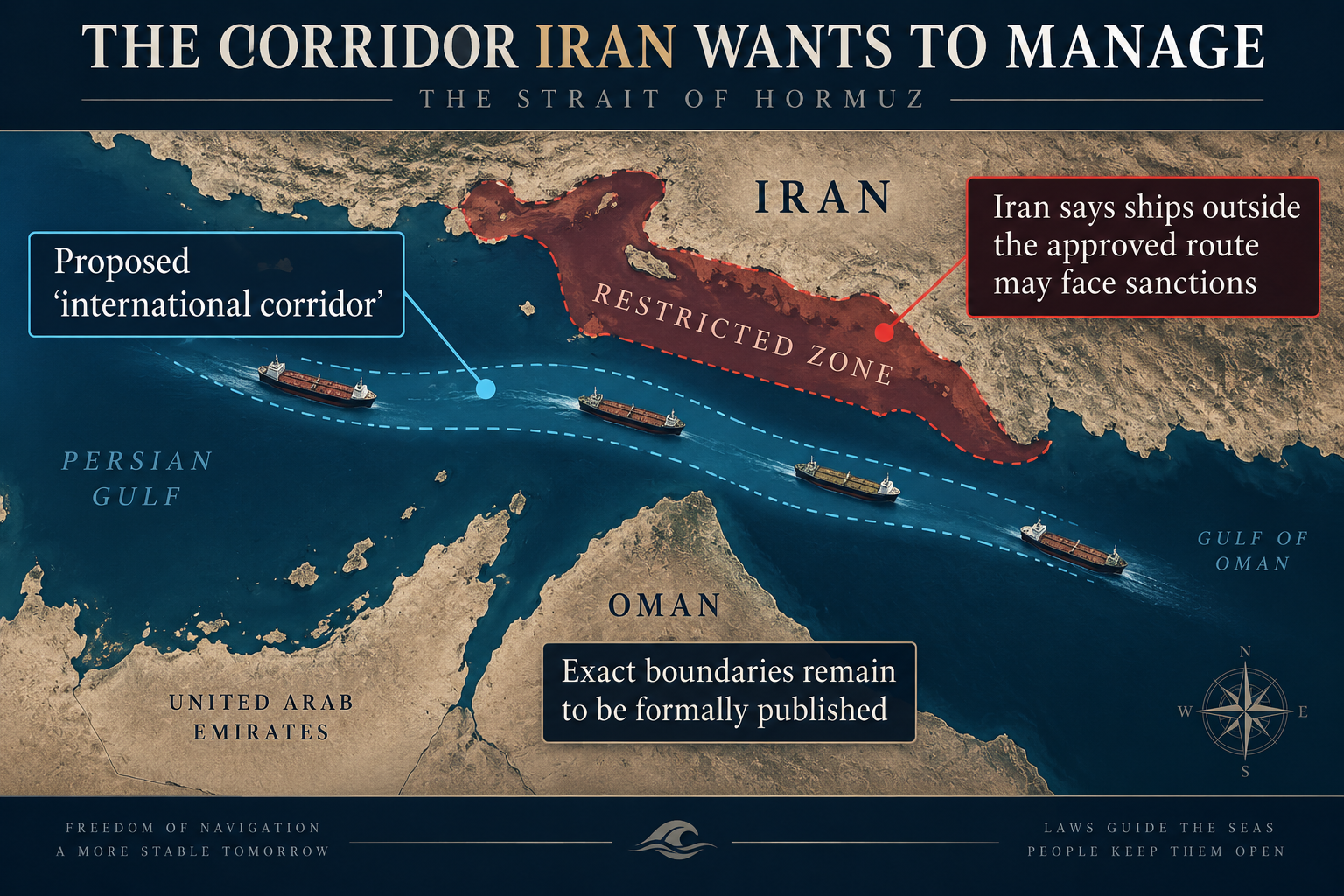
The announcement lands in an ugly moment. A preliminary ceasefire reached in June has unraveled, and after a quiet August the strikes have resumed. U.S. Central Command reported that American forces struck three Iranian oil tankers over the weekend, including one off Kharg Island, Iran’s principal oil-export hub, following attacks by Iran’s Islamic Revolutionary Guard Corps (IRGC) on U.S. warships in the region. Oil markets reacted the way they always do to the word “Hormuz”: Brent crude pushed above $97 a barrel, and commodity-ship transits through the Strait fell to the lowest traffic since May.
In the days since, Iran has not waited for the ink to dry. Its Revolutionary Guard has begun describing shipping lanes as a “prohibited and unsafe zone” and has extended targeting threats even to tankers berthed in Kuwait and Bahrain — enforcement, in practice, running well ahead of any formally signed map or filing. The corridor is being drawn not only on paper, but based on the range of a missile.
The Bypass Was the Backup — Until It Wasn’t
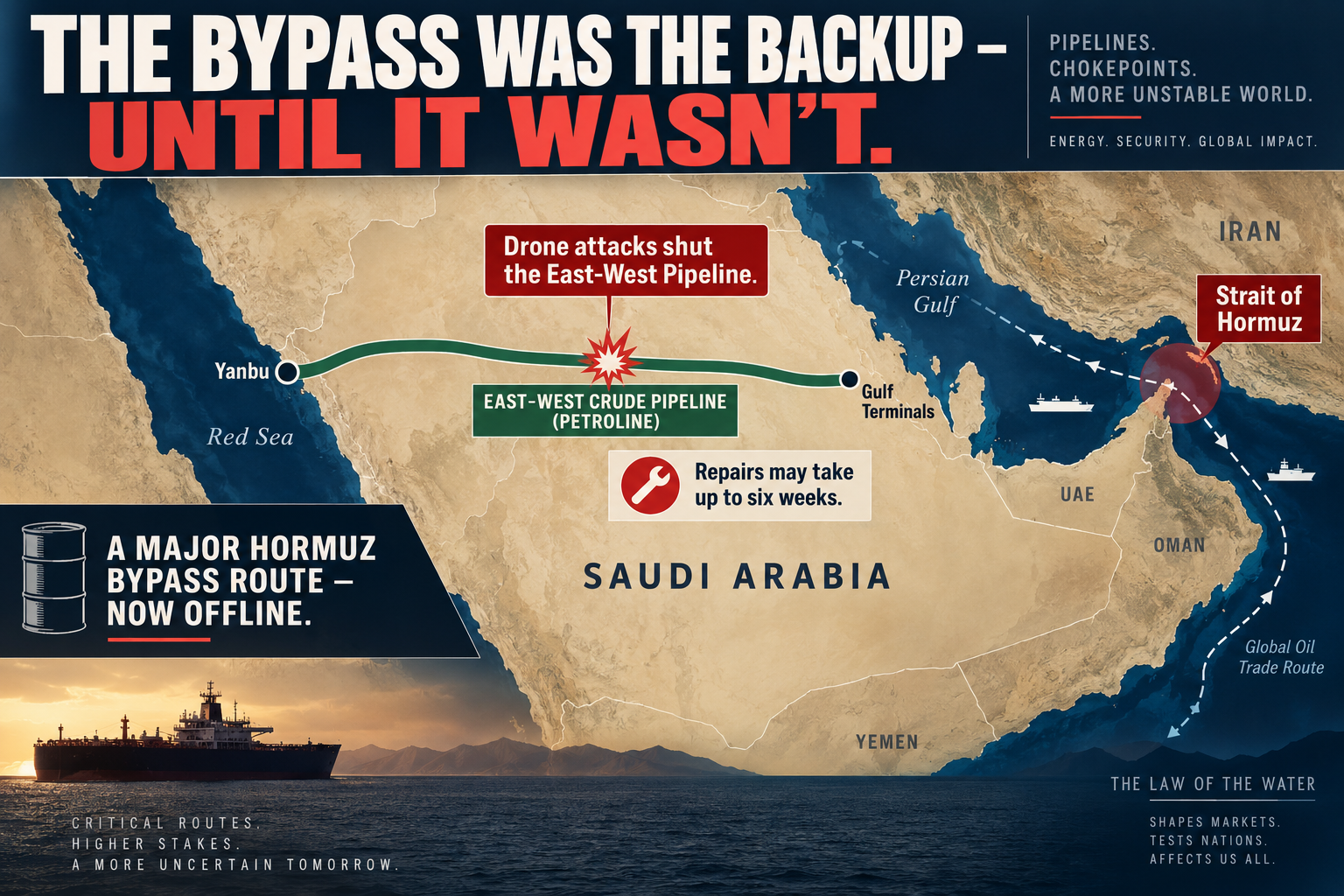
If the Strait is the front door, Saudi Arabia’s East-West crude pipeline — the Petroline — has long been the back one: a conduit capable of moving as much as seven million barrels a day across the Arabian Peninsula to the Red Sea, deliberately routed to skirt Hormuz altogether. For months it has been the reassurance every energy minister reached for whenever the Strait made headlines: even if the chokepoint tightens, the argument went, the oil can still bypass it.
That reassurance took a direct hit. On September 11 and 12, drones — traced by Saudi authorities to Iran-aligned groups in Maysan province, in southeastern Iraq — struck the Petroline, and Riyadh shut it down as a “precautionary” measure, with repairs estimated at five to six weeks. Brent crude, roughly $97 when the corridor was first announced, pushed toward $108 a barrel. For the first time in this long conflict, both the door and the detour were closing at once — which is precisely what turns a regional quarrel into a global one, and what makes the terms of passage suddenly matter to everyone downstream.
Can Iran Actually Do This
Here the enthusiasm of the announcement collides with the law of the sea, and the collision is worth understanding.
Straits like Hormuz are governed by a regime called transit passage, set out in the United Nations Convention on the Law of the Sea (UNCLOS). Through a strait used for international navigation, ships and aircraft enjoy the right of continuous and expeditious passage, and — critically — a coastal state may not suspend it. A coastal state bordering a strait may propose sea lanes and traffic-separation schemes, but only in cooperation with the International Maritime Organization (IMO), the United Nations body that sets global shipping rules, and only where they genuinely serve safe navigation. A lane imposed unilaterally, gated by permission and enforced with a sanctions list, is a very different animal.
There is a further wrinkle worth noting for candor’s sake: Iran signed UNCLOS but never ratified it, and the United States is not a party either — yet Washington has long treated transit passage as binding customary international law, and enforces it accordingly. In other words, the two governments most directly at odds here both operate against the backdrop of a legal norm that neither has formally adopted. That is the strange, contested water in which the world’s tankers now have to navigate.
None of this is to say Iran cannot make life difficult. A country that can close a strait can certainly complicate one. The legal question — whether Tehran may lawfully compel foreign vessels into a corridor of its own drawing — is separate from the practical one every master and shipowner now faces: what do we actually do when the ship is expected to sail anyway?
Where the Chart Meets the Crew
That practical question is exactly where maritime law stops being abstract, and it is the thread that has run through this entire series.
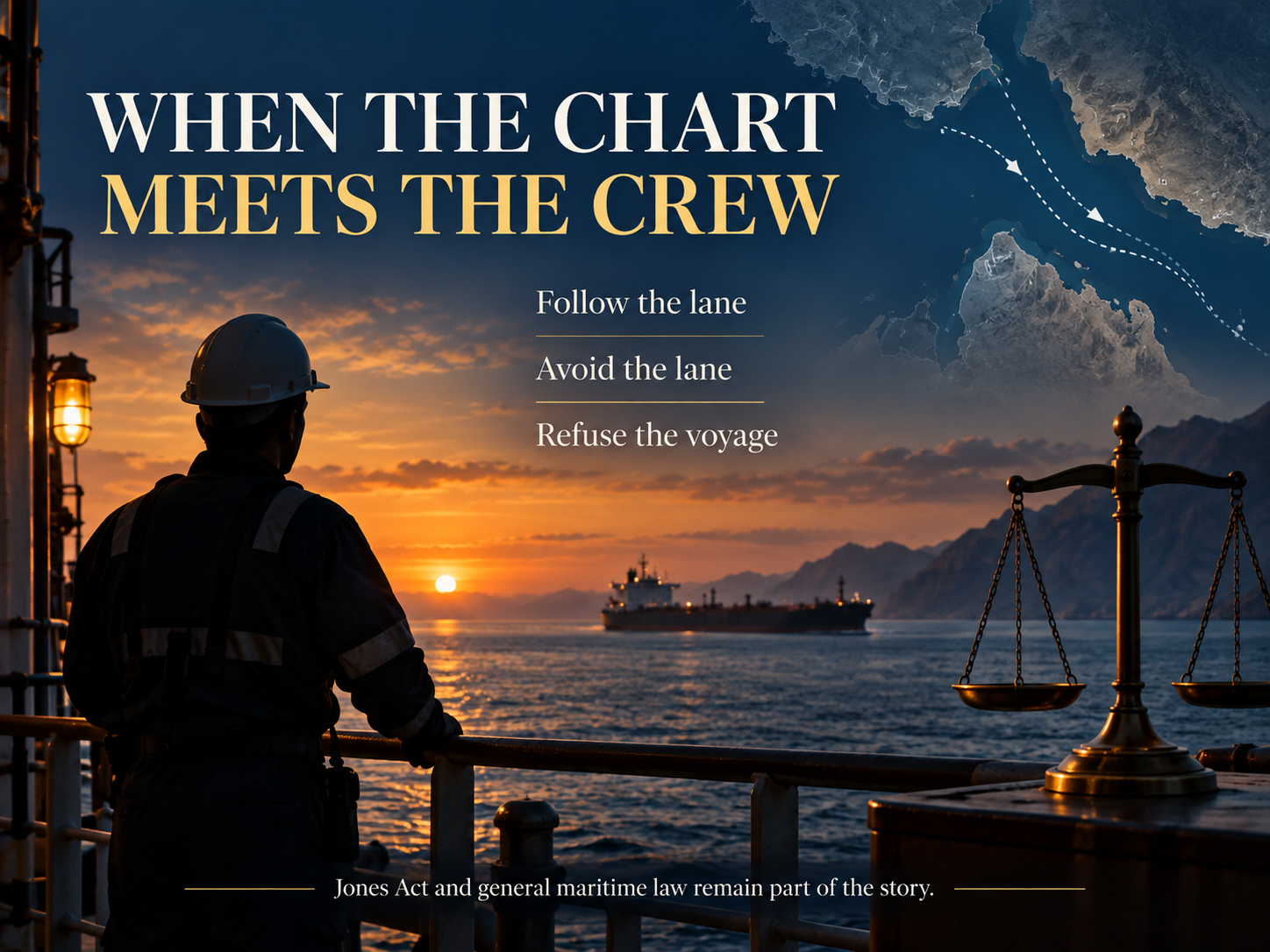
When an owner orders a vessel into contested water — a mined channel, a blockade line, or now a corridor where deviating a mile to port or starboard invites sanctions — the crew does not forfeit its protections at the water’s edge. Under the Jones Act and the General Maritime Law, a seaman injured because an employer sent the ship knowingly into harm’s way may have claims for negligence and for the unseaworthiness of a vessel dispatched into a combat zone without adequate protection or clear protocols. Employers owe an affirmative duty to warn of known dangers, and mariners retain a right to refuse genuinely unsafe passage, with the master’s overriding authority to protect ship and crew as the anchor. We walked through those doctrines in detail in Running Dark Through Hormuz: The Quiet Campaign to Keep Shipping Moving, and they apply with even more force when the “route” itself has become a legal minefield.
A corridor drawn by one nation, policed by a sanctions list, puts the crew in a genuine bind: follow the lane and risk a foreign navy’s blockade; avoid it and risk Iran’s sanctions list; refuse the voyage and risk your livelihood. When a company resolves that bind by pointing the bow into danger, the law has something to say about who bears the risk — and it is rarely the deckhand.
Why This Reaches the U.S. Gulf Coast
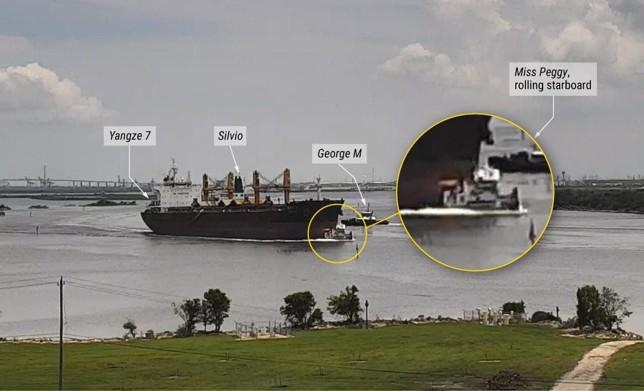
The same duties that would protect a tankerman ordered into an Iranian corridor protect a deckhand on the Houston Ship Channel, a barge worker on the Intracoastal Waterway, and a crewed charter crossing Galveston Bay. A seaman does not surrender the Jones Act, maintenance and cure, or the right to a seaworthy vessel by working somewhere dangerous — those are precisely the places the rights were built for.
And the economics travel, too. When the terms of passage through Hormuz turn unsettled — a new zone here, a struck tanker there, oil ticking up a dollar at a time — the tremor runs down the supply chain to the people who load, haul, and insure the cargo on the Texas coast. A drayage margin, a terminal’s throughput, a mariner’s overtime: these are not abstractions on the U.S Gulf. They are the practical weather of the maritime economy, and they shift with every new line drawn on the chart out of Tehran.
After all, a chart is only as good as the promise behind it — and the mariner, not the mapmaker, is the one who has to sail across the part that still says here be dragons.
Maritime Trivia Question!
Q: We often mention a ship’s “chart,” but why is a nautical map called a chart and not simply a map?
A: The word descends from the Latin charta — a leaf of papyrus, a sheet of paper — by way of the French carte. Over centuries, sailors reserved “chart” for the specialized sheet that showed not the land but the water: its depths, its hazards, its safe passages. A map tells you where things are; a chart tells you how to survive getting there. The distinction is a sailor’s whole philosophy in a single word — the sea is not a place you look at, but a place you cross.
We at the Herd Law Firm are proud to fight for seamen, maritime workers, shippers, and passengers in all types of personal injury, death, and maritime commercial claims. As maritime attorneys (and sailors ourselves!) located in northwest Houston, we never waver in our commitment to help maritime workers, businesses, and their families when they are injured, mistreated, or shortchanged.
The information in this post is for general informational purposes only and does not constitute legal advice. For questions specific to your maritime law issue, please contact us at 713-955-3699 or at Charles.Herd@HerdLawFirm.com.
Sources
- Ghania, Yasmine, and Hatem Maher. “Iran Says to Announce New Restricted Zone in the Gulf in the Coming Days.” Reuters (via gCaptain), September 7, 2026. https://gcaptain.com/iran-says-to-announce-new-restricted-zone-in-the-gulf-in-the-coming-days/
- “Iran Plans New Gulf Restricted Zone and Strait of Hormuz Shipping Corridor.” Cyprus Mail (Reuters), September 7, 2026. https://cyprus-mail.com/2026/09/07/iran-plans-new-gulf-restricted-zone-and-strait-of-hormuz-shipping-corridor
- “What We Know About Iran’s Planned Restricted Zone Around Hormuz.” The New Arab, September 7, 2026. https://www.newarab.com/analysis/what-we-know-about-irans-planned-restricted-zone-around-hormuz
- “Iran Says It Will Act Against Vessels Beyond Strait of Hormuz.” The National, September 7, 2026. https://www.thenationalnews.com/news/gulf/2026/09/07/iran-threatens-to-impose-restricted-zone-outside-strait-of-hormuz/
- “Why Saudi Arabia’s East-West Pipeline Matters for Global Oil.” Al Jazeera, September 14, 2026. https://www.aljazeera.com/news/2026/9/14/why-saudi-arabias-east-west-pipeline-matters-for-global-oil
- “Saudi Arabia Shut Down East-West Crude Oil Pipeline After Multiple Attacks by Drones From Iraq.” CNBC, September 11, 2026. https://www.cnbc.com/2026/09/11/saudi-arabia-shut-down-east-west-crude-oil-pipeline.html
- “Can Iran Enforce a Restricted Zone in the Strait of Hormuz?” Al Jazeera, September 7, 2026. https://www.aljazeera.com/news/2026/9/7/can-iran-enforce-a-restricted-zone-in-the-strait-of-hormuz
- United Nations. “United Nations Convention on the Law of the Sea” (Part III, transit passage through straits used for international navigation, arts. 37–44). https://www.un.org/depts/los/convention_agreements/texts/unclos/unclos_e.pdf
- Legal Information Institute, Cornell Law School. “46 U.S. Code § 30104 – Personal injury to or death of seamen” (the Jones Act). https://www.law.cornell.edu/uscode/text/46/30104
- Herd Law Firm, PLLC. “Tehran’s Toll Booth: What the Persian Gulf Strait Authority Means for Shipping.” https://herdlawfirm.com/firm-update/tehrans-toll-booth-what-the-persian-gulf-strait-authority-means-for-shipping/
- Herd Law Firm, PLLC. “Running Dark Through Hormuz: The Quiet Campaign to Keep Shipping Moving.” https://herdlawfirm.com/firm-update/running-dark-through-hormuz-the-quiet-campaign-to-keep-shipping-moving/