The United States has declared itself “the Guardian of the Hormuz Strait,” reinstated a blockade of Iranian shipping, and proposed a 20% fee on all cargo crossing the world’s most important oil chokepoint. Two governments now claim the right to charge for the same stretch of water — and the mariners in between are the ones who must actually make the transit.
There is an old superstition among sailors about naming a thing before anyone has worked out what it might mean. On Monday, in a post on Truth Social, President Donald Trump announced that the Strait of Hormuz “is OPEN, and will remain OPEN, with or without Iran,” that the United States is reinstating a blockade of Iranian shipping, and that America will henceforth be known as “the Guardian of the Hormuz Strait” — a guardianship for which it expects to be reimbursed at a rate of 20 percent on all cargo shipped through the waterway.
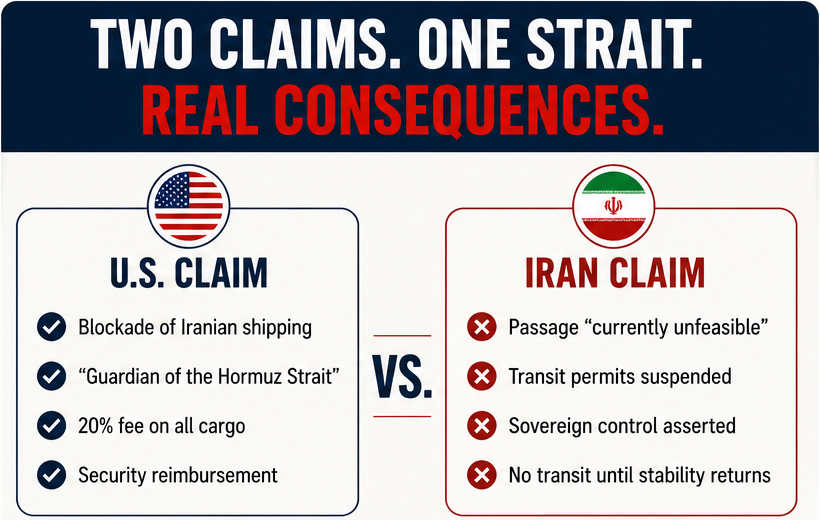
That is an extraordinary sentence to read on a Monday morning. It is also, for the men and women standing watch out there, an entirely practical problem. Because Iran’s Persian Gulf Strait Authority (PGSA) announced on the very same day that passage through the strait was “currently unfeasible” and that it was suspending transit permit applications until stability returns. Two sovereigns, two claims, one strait roughly twenty-one miles wide at its narrowest. The chart does not care who is right.
WHAT WAS ACTUALLY ANNOUNCED
- A renewed blockade. The President described it as stopping only Iranian ships and Iran’s customers from entering or leaving, with all other nations retaining “fair and open use” of the strait.
- A 20% cargo fee. Framed as reimbursement for the cost of providing security, with the “process and formation” to begin immediately.
- Escalating strikes. U.S. Central Command (CENTCOM) reported successive waves against Iranian air defenses, coastal radar, missile and drone capability, and Islamic Revolutionary Guard Corps (IRGC) small boats — including the first reported combat use of American one-way attack sea drones.
- A ship on fire. Less than a day before the announcement, the Cyprus-flagged container ship M/V GFS Galaxy was struck by a projectile east of Oman. The blow tore into her stern, set the engine room ablaze, and forced her crew into a lifeboat. Omani forces recovered twenty-three; one seafarer was reported missing.
Notice which of those four items is not a policy declaration. Whatever else is unresolved, the GFS Galaxy is a real hull with real people in her, and the fire in her engine room did not wait for a legal framework.
THE TOLLBOOTH PROBLEM
Under the United Nations Convention on the Law of the Sea (UNCLOS), vessels of all nations generally enjoy a right of transit passage through international straits used for international navigation. The United States is not a party to UNCLOS, though it has long recognized much of the convention’s navigational architecture as customary international law — and has spent decades, at considerable expense, defending exactly that principle: that a strait is not a turnpike.
So the shipping world is now watching Washington propose a charge on the same water it once insisted no one could charge for, while Tehran proposes a permit regime of its own. The International Maritime Organization (IMO) has said plainly that it opposes fees for passage through straits used for international navigation. For an owner, a charterer, or an underwriter, the questions multiply quickly: assessed on what value, collected by whom, at which port, under what executive order? As of this writing the White House has issued no order, no legal framework, and no guidance to shipowners, cargo interests, insurers, or port authorities.
For a master with a laden tanker and a fixed laycan, however, the ambiguity resolves into something far simpler and far worse: somebody is going to tell me to go anyway.
WHAT U.S. MARITIME LAW SAYS ABOUT “GO ANYWAY”
Here is the part that matters to our clients. The Jones Act and the General Maritime Law were built around an unavoidable feature of life at sea: the ship is both the workplace and the only ground beneath your feet. You cannot walk off the job in the middle of a chokepoint. Because the employer controls whether the crew goes into harm’s way, the law puts real weight on that decision.
- Jones Act negligence. An employer is liable where its negligence played “any part, even the slightest” in causing a seaman’s injury. That famously low threshold is not an accident; it reflects the judgment that those who profit from sending sailors to sea must answer when sailors are harmed.
- Unseaworthiness. A vessel owner is strictly liable when the ship — her equipment, her condition, her officers and crew, her fitness for the voyage ordered — is not reasonably fit for its intended purpose. A voyage ordered into an active shooting gallery, without hardening, protocols, or a coherent answer to competing naval instructions, is precisely the kind of order that invites the question.
- Maintenance and cure. The old admiralty obligation, owed regardless of fault, to pay an injured seaman’s living expenses and medical care until he reaches maximum medical improvement (MMI). It does not care whose missile it was.
- The duty to warn. Employers must warn crews of known dangers. When the IMO has condemned attacks on merchant ships, when flag and labor-supplying states are issuing advisories, and when a boxship has just burned nine miles off Oman, the danger is not speculative. It is Monday’s news.
Add to that the war risk provisions that appear in most conflict-zone employment contracts and collective bargaining agreements — enhanced insurance, war risk bonuses, and, critically, the right to refuse a voyage into a designated high-risk area. And behind all of it stands the oldest rule on the water: the master’s overriding authority to protect ship and crew.
A 20% cargo fee, a blockade, and a rival permit office do not suspend any of that. If anything, they sharpen it. A commercial dispute between governments over who gets paid for the water is not a lawful reason to send a crew through it blind.
WHY THIS REACHES THE HOUSTON SHIP CHANNEL
The crude that clears Hormuz sets the price of the barrel that moves past itf, and because the same duties travel. The Jones Act, the warranty of seaworthiness, and maintenance and cure protect a tankerman off Bandar Abbas and a deckhand off Baytown by the same logic. Longshore and Harbor Workers’ Compensation Act (LHWCA) coverage protects the terminal hands who take those cargoes when they finally land.
Governments will argue about who is the guardian of the strait. The men and women on watch have been guarding it all along, four hours at a time, for no fee whatsoever. The least the law can do is stand behind them when someone orders them through it.
MARITIME TRIVIA QUESTION!
Q: A master caught between Washington’s blockade and Tehran’s permit office is, in the old phrase, “between the devil and the deep blue sea.” Most people hear that as a choice between Satan and drowning. It is not. What is the devil on a wooden ship?
A: The devil was a seam — by most accounts the longest and most awkward one on the hull, running along the waterline or the deck edge. Caulking it meant working from a plank slung outboard, with the seam at your chest and nothing but open water beneath your heels: literally between the devil and the deep blue sea. (The same seam gives us “the devil to pay,” since paying a seam meant sealing it with hot pitch — a filthy, scalding job nobody wanted.) The phrase was never about damnation. It was about having a bad job in front of you and no safe footing behind.
We at the Herd Law Firm are proud to fight for seamen, maritime workers and passengers in all types of personal injury and death claims. As maritime personal injury attorneys (and sailors ourselves!) located in northwest Houston, we never waver in our commitment to help these maritime workers, passengers, and their families when they are injured or mistreated.
The information in this post is for general informational purposes only and does not constitute legal advice. For questions specific to your maritime law issue, please contact us at 713-955-3699 or at Charles.Herd@HerdLawFirm.com.
SOURCES
- CBS News. “Trump says U.S. will be ‘guardian of the Hormuz Strait’ and is reinstating Iranian blockade.” July 13, 2026. https://www.cbsnews.com/news/trump-iran-war-us-guardian-strait-of-hormuz-get-paid/
- CNBC. “Trump proposes 20% toll on cargo through Strait of Hormuz; restarts Iran blockade.” July 13, 2026. https://www.cnbc.com/2026/07/13/trump-iran-hormuz-strait-charge-reimburse.html
- Bloomberg. “Trump to Restart Iran Blockade as US Plans 20% Hormuz Charge.” July 13, 2026. https://www.bloomberg.com/news/articles/2026-07-13/trump-says-us-will-be-reimbursed-20-rate-for-hormuz-traffic
- The Hill. “Trump reimposes blockade on Strait of Hormuz, declares 20 percent US toll on shipping.” July 13, 2026. https://thehill.com/homenews/administration/5965639-trump-reinstates-naval-blockade-iran/
- Lloyd’s List. “Strait of Hormuz conflict escalates as latest Iran strike leaves boxship on fire.” July 12, 2026. https://www.lloydslist.com/LL1157811/Strait-of-Hormuz-conflict-escalates-as-latest-Iran-strike-leaves-boxship-on-fire
- Cyprus Mail. “Cyprus-flagged ship attack sends Hormuz traffic into retreat.” July 13, 2026. https://cyprus-mail.com/2026/07/13/cyprus-flagged-ship-attack-sends-hormuz-traffic-into-retreat
- Ship & Bunker. “23 Crew Members Rescued After Boxship Attack off Oman.” July 12, 2026. https://shipandbunker.com/news/emea/731724-23-crew-members-rescued-after-boxship-attack-off-oman
- Legal Information Institute, Cornell Law School. “46 U.S. Code § 30104 — Personal injury to or death of seamen” (the Jones Act). https://www.law.cornell.edu/uscode/text/46/30104
- United Nations. “United Nations Convention on the Law of the Sea” (Part III, transit passage through straits used for international navigation). https://www.un.org/depts/los/convention_agreements/texts/unclos/unclos_e.pdf