Small modular reactors, shipyard construction, island energy security, and the maritime law questions that may follow.
Floating nuclear power is emerging as one of the more significant new concepts in offshore energy. Once treated as a niche or experimental idea, floating nuclear power plants are receiving renewed attention because of several converging pressures: rising electricity demand, reliable low-carbon power, limited land availability, energy-security concerns, and the growing need for fresh water in coastal and island communities.
However, floating nuclear power is not merely a nuclear-energy issue — it is a shipyard, towage, mooring, inspection, marine-operations, offshore-support, emergency-response, insurance, and maritime-liability issue. The success of these projects may not only mean more offshore jobs, but new questions about worker safety, vessel operations, regulatory compliance, and legal responsibility when something goes wrong.
The Basic Concept
A floating nuclear power plant, often called an FNPP, is a nuclear generation unit mounted on a barge, vessel, or floating platform. Rather than being built entirely at a fixed land-based site, the unit may be fabricated in whole or in part in a controlled shipyard environment, transported by water, moored near a coastal demand center, and connected to the local power grid.
The appeal is practical: many coastal regions, remote industrial sites, ports, mines, and island nations need dependable electricity, but face hard limits on land availability, fuel supply, grid capacity, and access to conventional infrastructure/logistics. A floating nuclear unit could potentially provide steady, reliable electricity, without requiring a dedicated site ashore.
For small island nations, developing states, and remote coastal regions that rely heavily on imported diesel or fuel oil — a dependence that exposes them to volatile prices, difficult logistics, supply interruptions, and high electricity costs — floating nuclear power could offer a more stable energy alternative.
Some designs also may produce heat for industrial use or support desalination, the process of removing salt from seawater to produce freshwater. Where energy security and water security are closely linked, that dual-use capability could meaningfully improve the financial case for deployment.
Why Small Modular Reactors Matter
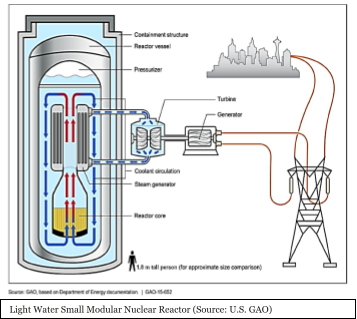
Most floating nuclear concepts rely on small modular reactor (SMR) technology — reactors designed to be smaller than traditional gigawatt-scale nuclear plants. There are 83 SMR designs at various stages of development or deployment worldwide, and they are often promoted as easier to standardize, manufacture, transport, and deploy in stages.
The modular concept matters. In theory, standardized designs and factory-style construction could reduce some of the cost and schedule risk historically associated with large nuclear projects. Shipyard fabrication also may allow for better quality control, more repeatable construction, and less disruption at the final deployment site.
Scale matters for offshore power markets too. A remote island grid, port, mine, desalination facility, or offshore industrial cluster may not need a massive conventional nuclear plant, but be better served by a smaller, steady, long-duration power source matched to local demand.
Depending on the design, some floating SMRs may require refueling only every three to seven years, with some advanced concepts being developed with fuel cycles extending up to 30 years. For regions that currently depend on regular fossil fuel deliveries, that could mean real improvements in energy independence, logistics, and price stability.
Current Technology and Global Development
Floating nuclear power is not entirely theoretical. Russia’s Akademik Lomonosov is the only operational floating nuclear power plant today, deployed to Pevek in the Russian Arctic using reactor technology derived from decades of Russian experience with nuclear-powered icebreakers and marine propulsion. Russia’s next unit, the Baim FNPP, is slated for commissioning in the Baimskaya ore zone in 2028.
Other countries and companies are studying or developing floating nuclear concepts based on compact pressurized water reactors, molten salt reactors, high-temperature gas-cooled reactors, fast-spectrum reactors, and microreactors — technologies that differ substantially in fuel type, operating temperature, cooling method, safety case, refueling needs, waste profile, and licensing pathway.
Current market analysis identified 118 floating nuclear reactor designs and prototypes currently in development globally. Some are designed primarily for electricity generation; others are intended to provide multiple outputs, including electricity, industrial heat, and desalinated water.
That distinction matters commercially, as floating nuclear power cannot be judged on a dollar-per-megawatt basis alone. In some markets, project value may depend on stacking several revenue streams: electricity sales, heat supply, desalinated water, grid-resilience services, industrial power, and/or long-term capacity contracts.
Priority Markets and Use Cases
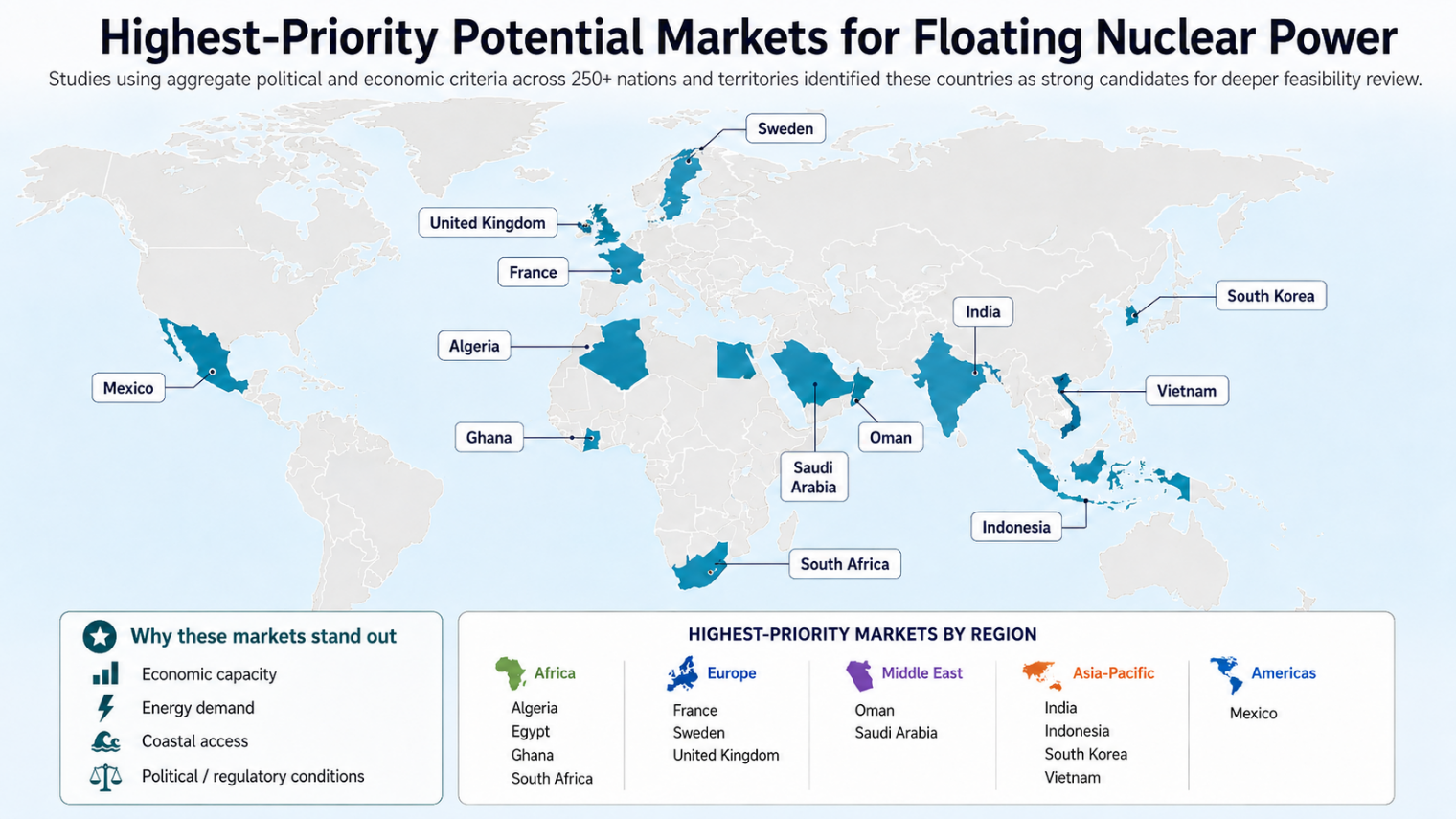
The strongest near-term case for floating nuclear power appears to be in locations where conventional energy options are expensive, unreliable, land-intensive, or difficult to scale. Potential use cases include:
- Remote coastal communities
- Small island developing states
- Ports and maritime industrial hubs
- Remote mines and resource projects
- Desalination facilities
- Offshore oil, gas, and energy infrastructure
- Military or strategic installations
- Industrial clusters requiring reliable process heat and power
The Maritime Industry’s Role
The floating nuclear model leans heavily on maritime and offshore capability. A floating nuclear unit must be designed for marine conditions, fabricated or integrated into a shipyard, transported to site, moored securely, connected to shore-side infrastructure, protected, inspected, maintained, and eventually decommissioned or replaced.
That work falls squarely within the experience of the maritime and offshore industries, which already manage complex floating assets, modular construction, tow-out operations, subsea connections, mooring systems, marine warranties, vessel coordination, inspection regimes, and long-term operations in harsh environments.
For shipyards and offshore contractors, floating nuclear could be a significant new market. It could mean new job categories in construction, installation, support-vessel operations, inspection, maintenance, emergency response, security, and decommissioning.
However, new work brings new risks. Floating nuclear projects would combine familiar offshore hazards with nuclear-specific requirements, such as radiation controls, restricted zones, emergency planning, specialized training, vessel traffic management, security protocols, heavy lifts, confined spaces, hazardous materials, and complex contractor coordination.
Regulatory and Commercial Challenges
Before commercial deployment, any project would need to address nuclear licensing, maritime regulation, coastal-state approval, flag-state issues, classification society requirements, physical security, emergency response, spent fuel management, insurance, liability, environmental review, and public reception.
International deployment could be especially complicated, as any floating nuclear unit might be designed in one country, built in another, owned by a separate corporate entity, operated by an international consortium, flagged under a particular registry, and deployed in the territorial waters or exclusive economic zone of a host nation.
This raises many regulatory questions:
- Which country licenses the reactor?
- Which maritime authority regulates the floating structure?
- Who controls emergency response?
- Which liability framework applies after an accident?
- How is spent fuel handled?
- What happens during a marine casualty, collision, grounding, storm event, or security incident?
- How are workers trained, monitored, and protected?
- Who is responsible for injuries to seamen, longshore workers, contractors, divers, or offshore support personnel?
Until these questions have clear answers, financing and insurance may be difficult to secure.
The Legal Dimension for Maritime Workers
If floating nuclear power becomes a working offshore industry, maritime injury claims may involve complicated overlaps between traditional maritime law and nuclear energy regulations.
Depending on the circumstances, injured American workers may have rights under:
- The Jones Act,
- U.S. General Maritime Law,
- Maintenance and Cure benefits,
- Unseaworthiness (i.e. breach of the “warranty of seaworthiness”),
- The Longshore and Harbor Workers’ Compensation Act (LHWCA),
- State workers’ compensation systems,
- Contractual indemnity provisions,
- International conventions, or
- Nuclear liability regulations.
The applicable law would likely depend on the worker’s status, the location of the injury, the nature of the vessel or platform, the employer’s role, the project structure, and the jurisdiction involved.
Several practical safety questions would likely sit at the center of any injury investigation, such as:
- Was the worker properly trained for the nuclear-maritime environment?
- Were radiation, security, and emergency procedures clearly explained?
- Was the vessel, barge, or platform reasonably fit for its intended purpose?
- Were contractors properly coordinated?
- Were support vessels given safe operating instructions?
- Were weather, towage, mooring, and marine-casualty risks adequately considered?
- Were workers exposed to hazards they were not qualified or equipped to handle?
- Were emergency plans realistic for offshore conditions?
Although floating nuclear power involves advanced technology, many of the core legal questions stay consistent: notice, training, supervision, seaworthiness, maintenance, safe equipment, adequate procedures, and accountability.
Watching the Water
With the regulatory, financial, and political hurdles yet to be addressed, floating nuclear power is unlikely to become a mass-market energy solution soon. But the concept keeps attracted attention because it speaks to genuine problems: reliable low-carbon power demand, land scarcity, island energy dependence, desalination needs, and industrial demand in coastal regions.
If (or really, when) floating nuclear power advances, it will lean on the same offshore competencies that have shaped modern maritime work for decades — shipbuilding, towage, marine engineering, offshore installation, inspection, vessel operations, and emergency response. And for maritime workers, the central issue is clear: new offshore energy infrastructure can’t be built in a way that treats worker safety as an afterthought, nuclear or otherwise. The people who build, tow, service, inspect, guard, and support these maritime platforms need clear rules, serious training, practical emergency plans, and legally accountable employers and operators.
Maritime Trivia Question!
What is a ship’s “flag state,” and why does it matter?
Answer:
A flag state is the nation whose flag a vessel flies and whose laws govern that vessel’s registration, safety standards, and regulatory oversight, regardless of where the vessel actually operates, or the nationality of the owner. This means a vessel may be designed in one country, built/maintained in another, owned by a third, and moored in a fourth’s territorial waters — sometimes leaving real uncertainty about which nation’s regulator is responsible for vessel safety, worker protection, and emergency response.
We at the Herd Law Firm are proud to fight for seamen, maritime workers and passengers in all types of personal injury and death claims. As maritime personal injury attorneys (and sailors ourselves!) located in northwest Houston, we never waver in our commitment to help these maritime workers, passengers, and their families when they are injured or mistreated.
The information in this post is for general informational purposes only and does not constitute legal advice. For questions specific to your maritime law issue, please contact us at 713-955-3699 or at Charles.Herd@HerdLawFirm.com.
Sources
1. Reiner, Alisa. “Floating Nuclear: A New Offshore Energy Frontier.” Marine Link / Offshore Engineer, June 25, 2026. https://www.marinelink.com/news/floating-nuclear-a-new-offshore-energy-540661
2. International Atomic Energy Agency (IAEA), floating nuclear power plant and SMR technology overviews.
3. Nuclear Threat Initiative, floating and marine nuclear reactor security analysis.
4. Office of Industry and Competitiveness Analysis, U.S. International Trade Commission, nuclear reactor supply chain reporting.
5. Lovering, J.R., Yip, A., and Nordhaus, T. “Historical Construction Costs of Global Nuclear Power Reactors.” Energy Policy 91 (2016): 371–382.
6. Nuclear Engineering International, floating and marine reactor industry coverage.
7. RBC Climate Action Institute, nuclear and clean energy market analysis.
8. Wikimedia Commons / U.S. Army, “MH-1A Sturgis” photograph.