
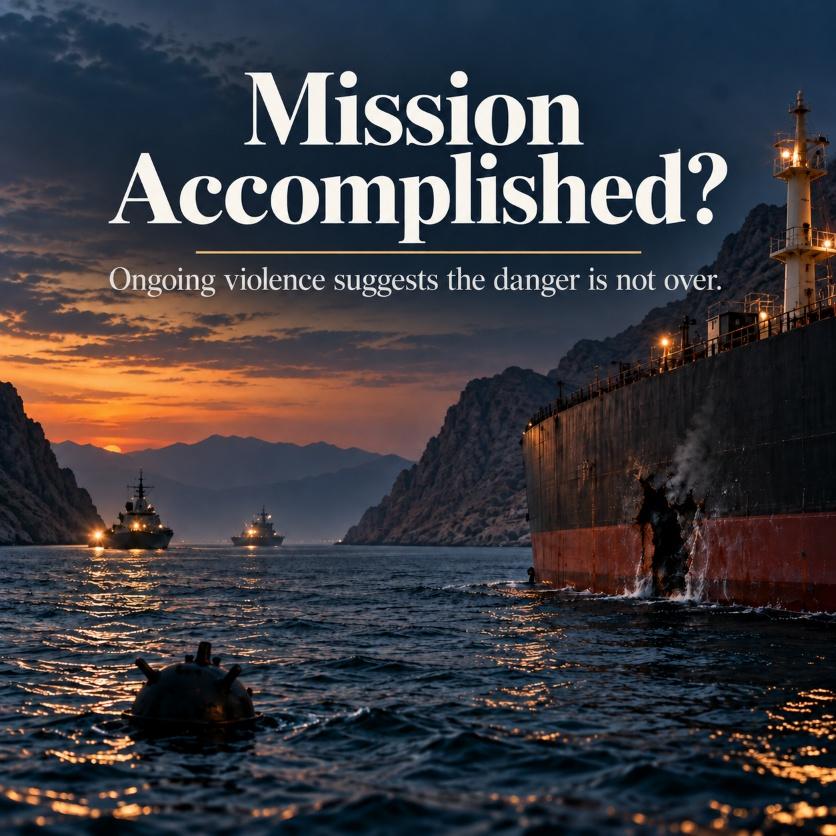
A projectile has opened another tanker just above the waterline near Khasab, even as Washington declares the mission finished and the mines cleared. For the mariners still threading this chokepoint — and for the Gulf Coast crews who share their law — a ceasefire on paper is not yet safe water under the keel.
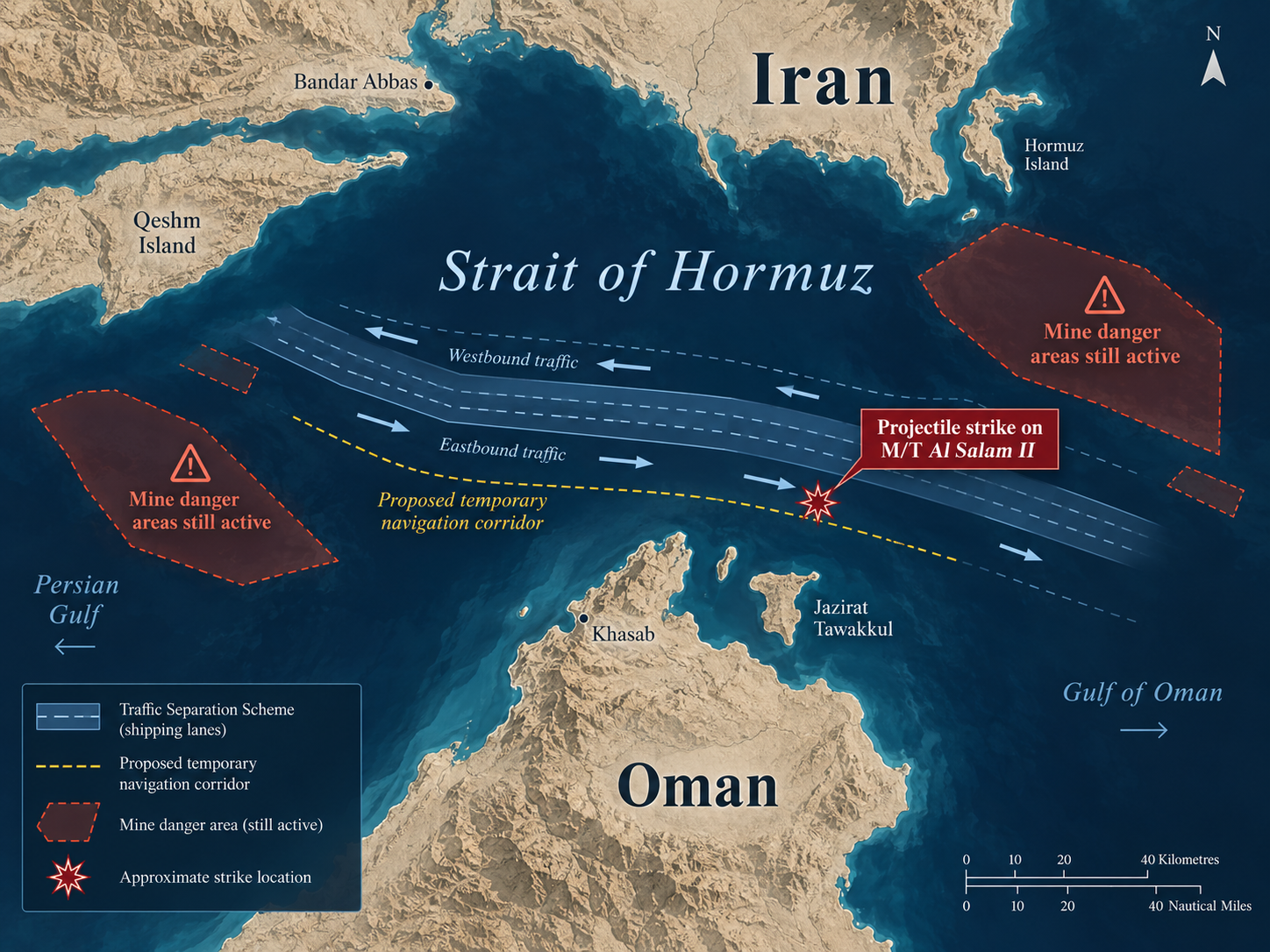
On August 25, 2026, at 1730 Coordinated Universal Time (UTC), a tanker steaming eastbound through the Strait of Hormuz was struck by an unknown projectile near Khasab, Oman. The Joint Maritime Information Center (JMIC) identified her as the M/T Al Salam II. The impact hit just above her waterline, opening up the hull, and started a fire the crew managed to extinguish. All hands were reported safe, with no oil spilled into the water. She later anchored roughly 0.8 nautical miles northwest of Jazirat Tawakkul to await tug assistance.
Yet, the same day’s headlines told a different story. President Donald Trump posted an image to Truth Social declaring “MISSION ACCOMPLISHED 2026” in Iran, following his statement that the U.S. Navy had removed or detonated every mine from international waters in the Strait.
The phrase carries its own cautionary history. In May 2003, President George W. Bush stood beneath a “Mission Accomplished” banner on the deck of the USS Abraham Lincoln to mark the end of major combat operations in Iraq — a declaration that became a byword for premature victory as the fighting, and the casualties, dragged on for years, and one Bush himself later called a mistake.
That same carrier is in the news again, for grimmer reasons. Through the summer of 2026, families and lawmakers raised alarms over a mental-health crisis among the crew of the USS Abraham Lincoln during a punishing extended deployment tied to this very conflict — amid reports of supply shortages and a sailor lost overboard — even as the President posted AI-generated images of lavish meals purportedly served to the crew aboard — images that sailors and other service members promptly disputed, posting their own photographs of the far sparser food they were actually being served. That a deck once draped in a “Mission Accomplished” banner is now the setting for so much quiet suffering is an irony we do not take lightly.
However, a hull with a fresh hole in it is a stubborn rebuttal. As we wrote in Narrow Waters, Wide Wake: The Scars of the Strait of Hormuz Crisis, the scope of this crisis is proving much greater than what headlines report.
What the Warnings Actually Say
The United Kingdom Maritime Trade Operations (UKMTO) office issued Warning 121-26 after the August 25th strike. And the JMIC — whatever the view from Washington — was clear about what remains in the water:
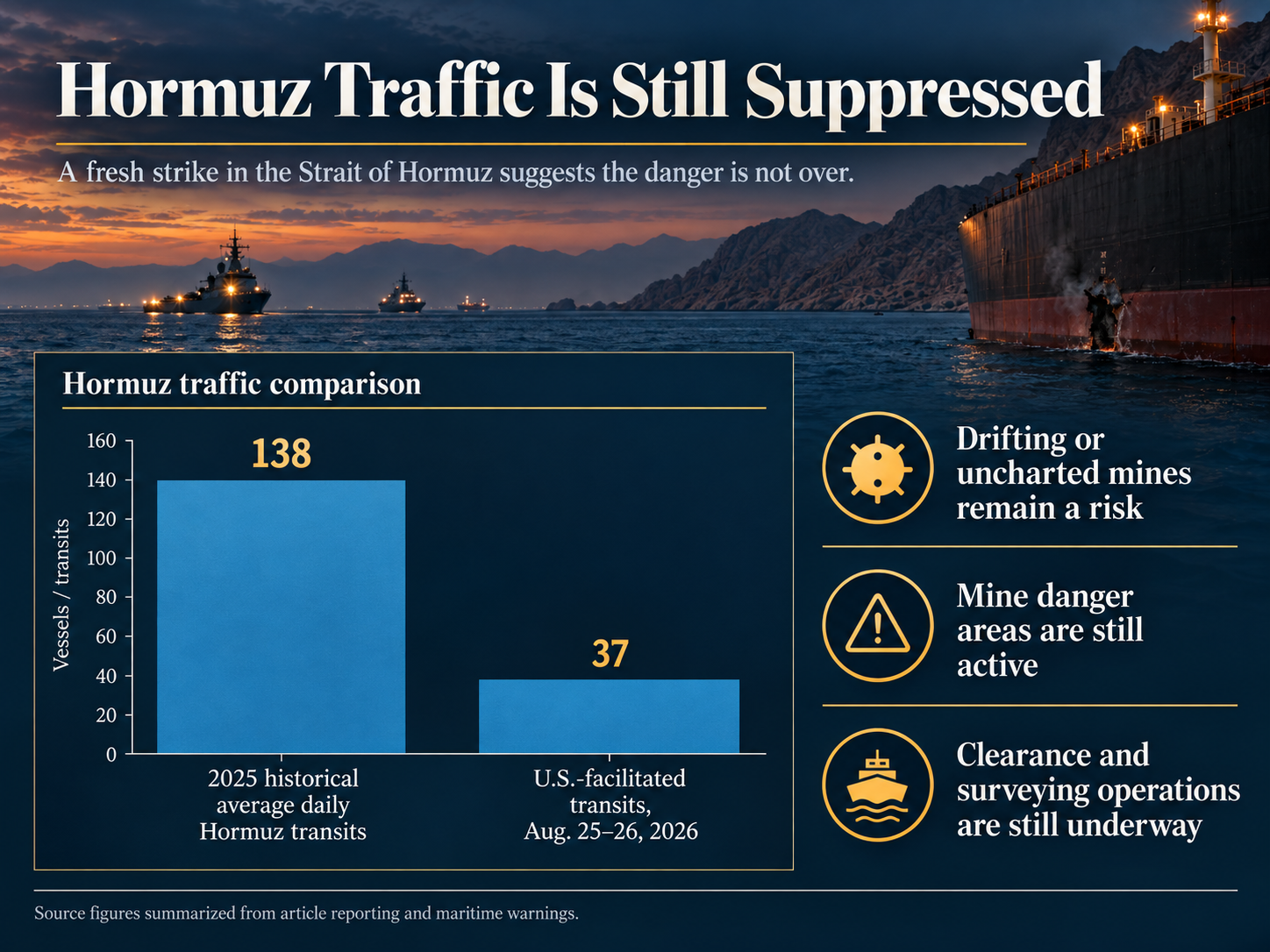
- A continuing risk from drifting or uncharted mines in and near the Strait’s Traffic Separation Scheme (TSS), with mine danger areas still active;
- Mine-risk reporting that “remains relevant,” with clearance and mine-surveying operations still underway throughout Hormuz; and
- An expectation that vessel traffic will stay suppressed on both the northern Iranian-controlled route and the southern Omani corridor.
The JMIC puts the 2025 historical average at roughly 138 transiting vessels per day. Over August 25 and 26, U.S. data recorded just 37 U.S.-approved and facilitated transits, while independent tracking showed non-facilitated commercial traffic still heavily suppressed — the combined weight of repeated vessel attacks, continued U.S. blockade enforcement, and prolonged regional tension. The M/T Al Salam II is what that risk looks like when it stops being a statistic.
A Corridor — On Paper
On that same Tuesday, Iran and Oman unveiled a phased framework to restore safe navigation: a temporary joint navigation corridor through Hormuz, a joint mine-clearing project, and continued technical talks toward a permanent corridor and the “future administration of the Strait” — traffic management, information exchange, and navigational and security services. The framework appears to operationalize the U.S.–Iran memorandum of understanding — a memorandum of understanding (MOU) signed in June that called for Iran to negotiate the Strait’s future with Oman. Those talks are now expanding; Qatar and Iran discussed the same framework in Tehran on Thursday.
In the weeks since, that paper corridor has aged badly. The preliminary June ceasefire has frayed, strikes have resumed across the Gulf, and Iran has moved to publish maps of an Iran-managed lane — enforced, it warns, by a sanctions list for any ship that strays outside it. We take up that development on its own terms — the restricted zone, the corridor maps, and what the law of the sea makes of them — in a companion post, Redrawing the Chart: Iran Moves to Manage — and Meter — the Strait of Hormuz. For our purposes here, the point is narrower: every one of those developments came after the word “accomplished.”
However, a potential corridor announced is not a corridor cleared. Readers who followed our earlier coverage of Tehran’s toll booth and the Persian Gulf Strait Authority will recognize the open question beneath the diplomacy: who controls the corridor, who charges for it, and what happens to a crew caught between the demands of a foreign military, our own military, and employers that still expect the ship to sail. (For the deeper backdrop on how this all began, check out Strait Talk: Uranium, Iran, and What’s Really at Stake in the Gulf.)
The Law Does Not Wait for a Ceasefire
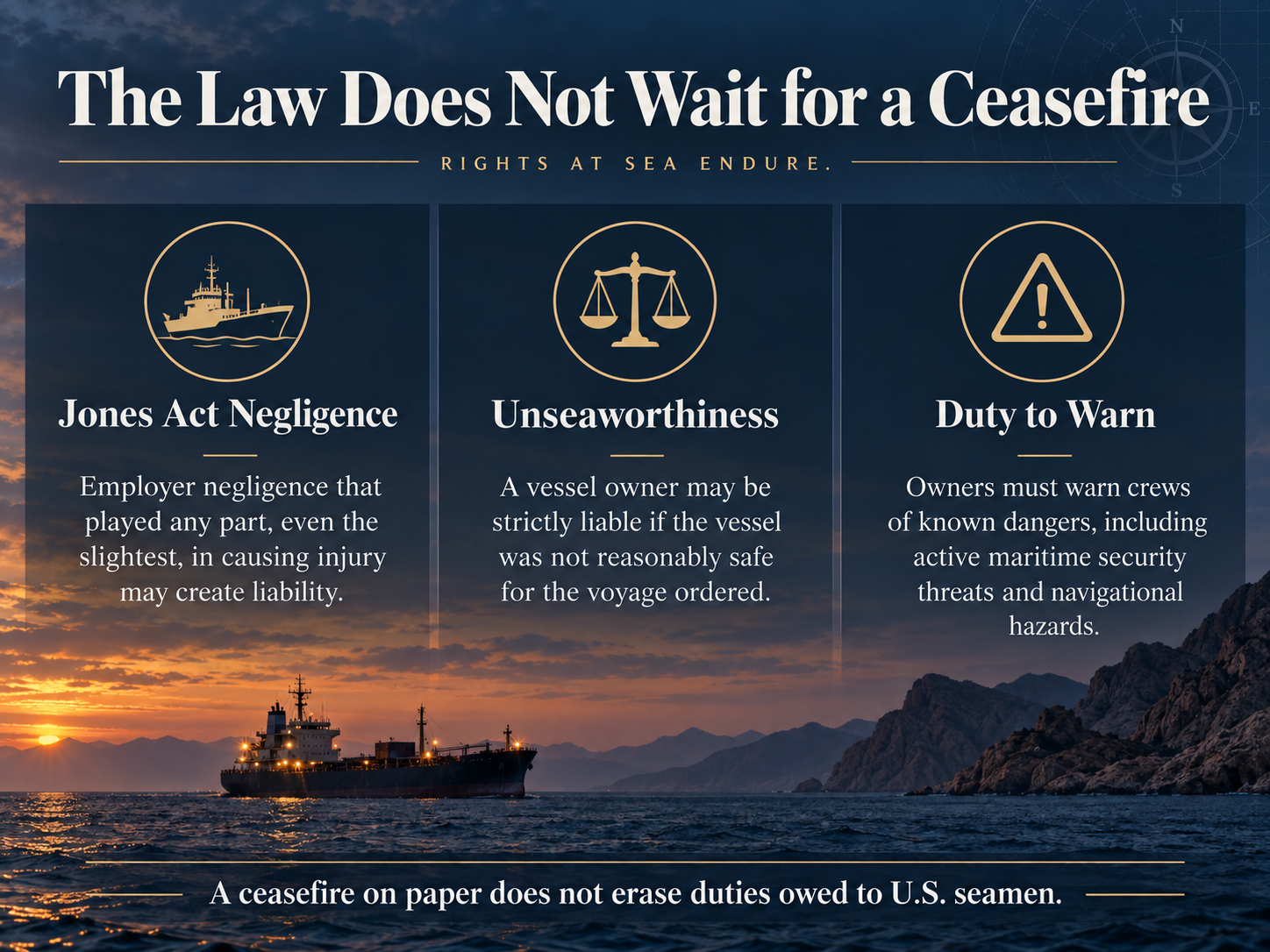
While a declaration of victory may inspire headlines, it does not change the duties a seaman’s employer owes the U.S. seamen aboard.
- Jones Act negligence asks whether an employer’s negligence played “any part, even the slightest,” in causing an injury. Ordering a vessel into a lane where projectiles are still finding hulls — after JMIC has said mine danger areas “remain active” — is exactly the kind of decision that low threshold was written to test.
- Unseaworthiness holds a shipowner strictly liable when the vessel is not “reasonably safe” for the voyage ordered. A transit sent through waters the very intelligence centers describe as still-mined may not clear that bar simply because a ceasefire was announced.
- The duty to warn requires employersto tell crews of known dangers. When UKMTO is publishing active warnings and JMIC is still surveying for mines, “we were told the mission was accomplished” is not the same as a seaworthy voyage or an informed crew.
As we wrote about in Running Dark Through Hormuz, ordering a crew into mined water — or onto a lights-out, transponder-off run past a hostile navy — is why these doctrines were built. The human cost of getting it wrong is not abstract; the thousands of seamen left stranded behind Hormuz during the war are a reminder of how long these crises can leave mariners without relief. The United Nations human rights office has reported at least 6,000 seafarers stranded on roughly 400 vessels — some abandoned outright, left without food, water, medical care, or the wages owed them.
Why This Reaches the Gulf Coast
Under U.S. law, when a seaman never surrenders the Jones Act, maintenance and cure benefits, or the right to a seaworthy vessel just by working somewhere dangerous — those places are where the rights matter most. Even when someone tells a crew the danger is over, we still ask the harder question: was the water actually safe when you ordered them into it?
Maritime Trivia Question!
Q: We reported the ship was struck “above the waterline,” and sailors have always drawn a hard distinction between that and an impact below it. Where does the ominously related phrase “the Plimsoll line” come from — and what does it actually mark?
A: It is named for Samuel Plimsoll, a 19th-century British reformer who fought the era’s “coffin ships” — vessels so dangerously overloaded that they routinely foundered, often well-insured, knowingly endangering the crew aboard. The Plimsoll line (formally the load line) is the marking on a hull showing the maximum depth to which she may legally be loaded; when the water reaches it, the ship is at her maximum legal capacity. It stands for a simple idea: there is a limit to how much risk you may lawfully burden the people who sail. After all, the whole point of the a load line is to keep the dangerous water on the outside!
We at the Herd Law Firm are proud to fight for seamen, maritime workers, shippers, and passengers in all types of personal injury, death, and maritime commercial claims. As maritime attorneys (and sailors ourselves!) located in northwest Houston, we never waver in our commitment to help maritime workers, businesses, and their families when they are injured, mistreated, or shortchanged.
The information in this post is for general informational purposes only and does not constitute legal advice. For questions specific to your maritime law issue, please contact us at 713-955-3699 or at Charles.Herd@HerdLawFirm.com.
Sources
- Schuler, Mike. “Tanker Hit in Strait of Hormuz as Trump Declares ‘Mission Accomplished’ in Iran.” gCaptain, Aug. 27, 2026. gcaptain.com
- “Projectile strikes, disables tanker near Strait of Hormuz.” UPI, Aug. 24, 2026. upi.com
- “Vessel hit by ‘unknown projectile’ in Strait of Hormuz, UKMTO says.” Al Jazeera, 2026. aljazeera.com
- “Iran and Oman Unveil Framework for Future Management of Strait of Hormuz.” gCaptain, 2026. gcaptain.com
- Legal Information Institute, Cornell Law School. “46 U.S. Code § 30104 – Personal injury to or death of seamen” (the Jones Act). law.cornell.edu
- Herd Law Firm. “Narrow Waters, Wide Wake: The Scars of the Strait of Hormuz Crisis.” herdlawfirm.com
- “Sailor went overboard from the USS Abraham Lincoln this month as conditions on the ship prompt lawmakers’ demand for answers.” CNN, Aug. 13, 2026. cnn.com
- “Reports about mental health, supply issues aboard USS Lincoln raise concerns.” NPR, Aug. 14, 2026. npr.org
- UN Office of the High Commissioner for Human Rights (OHCHR). “Stranded Hormuz Seafarers Abandoned for Months at Sea.” July 2026. ohchr.org



Leave A Comment
You must be logged in to post a comment.